
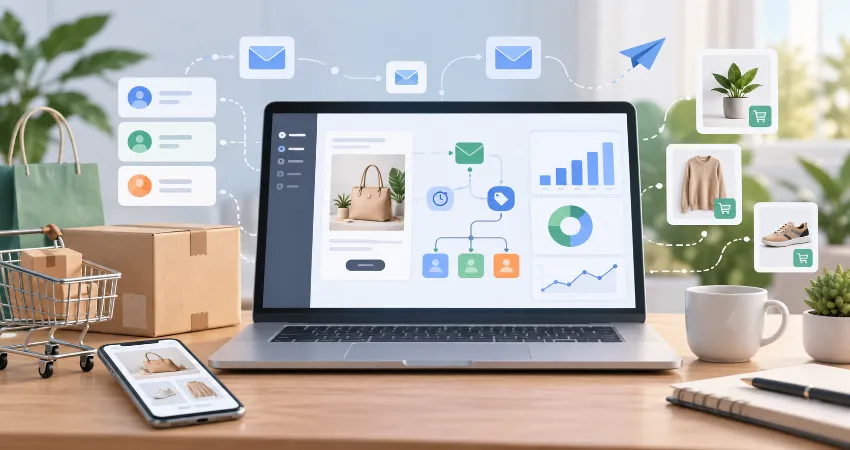
Email marketing for an ecommerce brand is more than sending newsletters. The strongest platforms connect customer profiles, products, browsing behavior, orders, and lifecycle events so messages reflect what shoppers actually do. That matters because a store with thousands of subscribers does not have one audience. It has new visitors, first-time buyers, repeat customers, inactive customers, and high-value shoppers at different stages.
Choosing a platform by template count alone is therefore a weak approach. A better evaluation looks at store-data depth, automation, segmentation, reporting, and how costs change as the list grows. The goal is not to find one universally “best” tool, but the platform that fits the brand’s current maturity and future workflow.
What Makes an Email Platform Ecommerce-Focused?
An ecommerce-focused platform should understand events such as product views, checkout starts, orders, repeat purchases, and customer value. It should turn those events into useful segments and automated workflows without constant spreadsheet work. Core journeys normally include welcome, cart recovery, post-purchase education, replenishment, cross-sell, win-back, and VIP communication.
Klaviyo
Klaviyo suits brands that want detailed profiles, event-based segmentation, and sophisticated automated flows. Its Shopify integration syncs customer and order data, while its integration ecosystem also supports major ecommerce platforms such as WooCommerce, BigCommerce, Magento, and Wix. The platform combines segmentation, forms, reporting, and automation around a shared customer-data layer.
Its main strength is control. Teams can create different journeys for first-time buyers, repeat purchasers, category buyers, and disengaged subscribers. That depth is useful once lifecycle marketing becomes a serious growth function, but it also creates more setup work. Klaviyo’s current free tier supports up to 250 active profiles and 500 monthly email sends, so established stores should model future costs before migrating.
Omnisend
Omnisend is built around ecommerce and combines campaigns, automation, forms, segmentation, email, SMS, and push messaging. It supports native connections with Shopify, BigCommerce, WooCommerce, Wix, and other commerce platforms. Once connected, store data can trigger workflows based on shopping behavior.
Its practical advantage is speed. Pre-built flows cover welcome, abandoned cart, browse abandonment, and post-purchase use cases, while segments can use purchase history, engagement, location, and lifecycle stage. It fits small and mid-sized brands that want meaningful ecommerce automation without designing every journey from scratch.
Shopify Messaging
Shopify Messaging, formerly Shopify Email, is attractive for merchants who want campaigns, automation, segmentation, store data, and reporting inside Shopify. Built-in tools support welcome, abandoned-cart, win-back, and upsell workflows, while customer segments can update from purchases, tags, browsing, and email behavior.
Eligible Shopify plans currently include the first 10,000 emails each month, followed by usage-based charges. That makes it appealing for newer stores that do not need a separate marketing stack. Brands requiring more complex journey logic or broader cross-platform data may eventually outgrow it.
Mailchimp
Mailchimp remains useful for brands that value a familiar campaign interface and already use its forms, landing pages, or broader marketing tools. Its Shopify integration supports automated use cases such as welcome messages, abandoned-cart reminders, back-in-stock communication, and customer segmentation.
The key question is whether familiarity outweighs the need for deeper ecommerce specialization. A team that mainly sends campaigns may be comfortable in Mailchimp, while a brand moving toward advanced behavioral journeys should compare the depth of event data and automation before committing long term.
ActiveCampaign
ActiveCampaign is useful when purchase data needs to influence a wider customer journey. Its Shopify integration supports purchase and abandoned-cart data, segmentation, automation triggers, goals, and ecommerce reporting. It also connects with WooCommerce and other commerce systems.
This makes it appealing for businesses combining ecommerce with longer nurture sequences or more complex customer-management processes. A store focused only on straightforward ecommerce email may find a more commerce-specific platform faster to operate.
Brevo
Brevo combines email, automation, transactional communication, and additional channels while supporting popular commerce integrations. Its pricing is more send-volume oriented than some profile-based alternatives. The current free plan includes 300 daily email sends, while paid tiers expand volume and automation capabilities.
Brevo can fit teams that value cost control and multiple communication channels, but feature availability matters. Advanced functions such as product recommendations, back-in-stock alerts, and deeper analytics can require higher tiers, so the lowest advertised price should not be treated as the true operating cost.
Choose by Lifecycle Maturity, Not by Feature Count
A new Shopify store may value Shopify Messaging or Omnisend for speed and simplicity. A growing direct-to-consumer brand with repeat-purchase behavior may benefit from Klaviyo’s deeper segmentation. ActiveCampaign can fit broader automation needs, Brevo can suit cost-aware multichannel teams, and Mailchimp remains practical where existing workflows matter.
Before switching, map every useful trigger, segment, form, product feed, discount process, and report. Then test the new system with real store events. A feature checklist is less valuable than confirming that a shopper enters the correct segment, receives the right message, exits after purchasing, and appears correctly in revenue reporting.
Deliverability Is an Operating Discipline
No platform can compensate for poor sending practices. Google requires bulk senders to use SPF, DKIM, and DMARC, keep complaint rates low, and support one-click unsubscribe for marketing messages. Yahoo applies similar expectations. Ecommerce brands should therefore authenticate their sending domains, collect clear consent, remove persistently unengaged contacts, process opt-outs promptly, and monitor sender reputation during any migration.
FAQs About Ecommerce Email Marketing Platforms
1. What is the best email platform for a small ecommerce store?
The best choice is usually the tool that can launch essential automations with low operational overhead. Shopify Messaging can suit Shopify-first stores, while Omnisend adds more dedicated ecommerce automation. Compare list size, sending volume, store integration, and likely growth before choosing.
2. Is Klaviyo only suitable for large brands?
No. Smaller brands can use Klaviyo, but its value becomes clearer when enough customer activity exists to justify advanced segmentation and multiple lifecycle flows. Very small stores may not yet use enough of that depth to justify the complexity or future cost.
3. Which automations should an ecommerce brand build first?
Start with welcome, cart or checkout recovery, post-purchase communication, and win-back. After those work correctly, add browse abandonment, replenishment, cross-sell, review requests, and VIP journeys where they match the product and buying cycle.
4. Should price be the main selection factor?
No. Compare how each provider charges for contacts, active profiles, sends, users, extra channels, and advanced features. A low starting price can become expensive as requirements grow, while a higher base price may already include capabilities the team would otherwise buy separately.
5. How important is Shopify integration?
For a Shopify brand, it is critical. Integration quality determines which customer, order, product, and behavioral events can power segments and automations. Test actual purchases, cart activity, and customer updates instead of assuming every integration syncs the same data.
6. Can marketing platforms also handle transactional email?
Some can, but transactional messages such as receipts, password resets, and shipping notices are operationally different from promotions. Confirm support carefully and avoid disrupting essential customer communication during a platform migration.
7. How often should an ecommerce list be cleaned?
List quality should be managed continuously. Segment long-term non-engagers and repeated bounces, run re-engagement where appropriate, and suppress contacts who remain inactive. This reduces unnecessary sending and helps protect sender reputation.
8. Are open rates enough to judge performance?
No. Use clicks, conversions, orders, revenue contribution, repeat purchases, unsubscribes, and automation performance as stronger business indicators. Email reporting becomes more useful when it connects engagement with actual customer outcomes.
9. When should a brand move to a more advanced platform?
Consider migrating when the current system blocks useful segmentation, requires frequent manual work, cannot support important lifecycle journeys, or provides weak ecommerce reporting. A migration should solve a defined operational problem, not simply add more features.
10. What should be tested before fully switching platforms?
Test authentication, consent status, unsubscribe behavior, customer and order sync, forms, product feeds, core flows, mobile rendering, tracking, and revenue attribution. Use real store events to verify the entire journey before sending broadly.
Conclusion
Email marketing platforms built for ecommerce should be evaluated as customer-data and lifecycle systems, not just campaign tools. Klaviyo offers deep control, Omnisend balances capability with usability, Shopify Messaging keeps operations simple, Mailchimp supports familiar workflows, ActiveCampaign connects commerce with broader automation, and Brevo offers flexible multichannel options.
The best platform is the one that fits today’s operating needs while leaving room for smarter segmentation, automation, and reporting tomorrow.