Bangladesh’s leather sector holds a position of genuine global significance — it is the country’s second-largest export industry after garments, generating roughly $1.2 billion in annual export revenue from leather goods alone.
The nation’s deep supply of bovine, caprine, and ovine hides, combined with generations of skilled craftsmen and a growing portfolio of certified tanneries, makes it one of the most compelling sourcing destinations for international buyers seeking genuine leather goods.
The sector’s trade association, formerly known as LFMEAB, rebranded as FLAXA (Footwear Leathergoods and Accessories Exporters Association) in March 2026 — a signal of how seriously the industry takes its global positioning.
This guide profiles ten of the strongest genuine leather goods exporters currently operating in Bangladesh. Each has a distinct position in the market — whether in footwear, bags, accessories, or tannery supply — and each serves the kind of international buyer who demands quality, compliance, and reliability in equal measure.
1. Apex Footwear Limited — South Asia’s Largest Leather Footwear Exporter
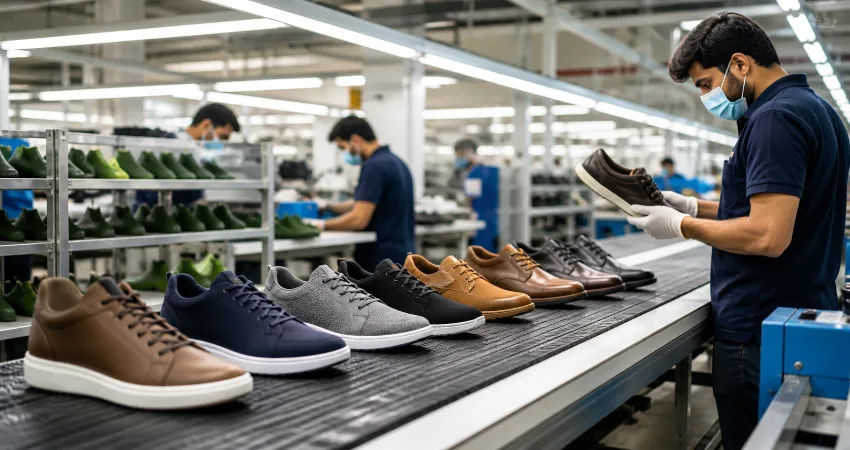
Founded in 1990 as Bangladesh’s first dedicated export-only footwear manufacturer, Apex Footwear has since grown into South Asia’s largest shoemaker by volume. The company employs more than 7,500 workers, produces several million pairs annually, and exports across 40 countries through partnerships with retailers including Macy’s, Deichmann, and ABC Mart.
It runs Bangladesh’s only LWG Gold-rated tannery — the highest environmental classification available for leather processing — and launches two international collections each year, adding over 1,000 new styles per season. Apex’s production infrastructure spans 120 cutting machines, 24 sewing lines, and 12 assembly lines.
2. SAF Industries Limited — Bangladesh’s First LWG Gold Tannery
Operating since 1958 under British ownership and later acquired by the Akij Group in 1979, SAF Industries carries a distinction that sets it apart from every competitor in the sector: it was the first tannery in Bangladesh to earn LWG Gold certification.
With a skilled workforce of approximately 300 specialists and full vertical integration across tanning and shoe manufacturing, SAF produces a range of leather products covering footwear, accessories, and raw processed hides. Its decades of operation under changing ownership models have built an institutional knowledge base that newer entrants simply cannot replicate.
3. Venezia Crafts and Leather Goods — Export-Only Bags and Small Leather Goods
Established in 2010 in Ashulia, Savar, Venezia Crafts began its commercial operations with a specific and demanding brief: making high-end leather bags for the Japanese market under technical collaboration with Japanese partners.
It later extended into Italian technical partnerships to develop small leather goods, and today claims to be Bangladesh’s leading producer of exotic crocodile-pattern leather wallets. The company maintains a catalogue of over 1,000 bag and small leather goods designs and serves both ODM and OEM buyers.
It never produces branded replicas — a clear market positioning that appeals to buyers who need authenticity guarantees across their supply chain.
4. Ananta Leather Collections Limited — Precision Manufacturing for Japanese Buyers
Part of the Ananta Group — a conglomerate established in 1992 with roots in garment manufacturing — Ananta Leather Collections entered the leather goods space in 2012 with a specific focus on the Japanese export market.
The company has maintained a record of zero missed delivery deadlines since launch, a statistic that speaks directly to the precision-oriented buyers it was designed to serve.
Its manufacturing facility covers 10,000 square feet with a specialist workforce of 70+ personnel, and it has the internal capability to develop new leather types, custom finishes, and rapid prototypes — making it a strong choice for buyers who need co-development as part of the sourcing relationship.
5. Bata Bangladesh — Heritage Production at Scale
Bata entered Bangladesh in the 1960s and has since built one of the most established leather manufacturing footprints in the country. Two dedicated production facilities — in Tongi and Dhamrai — together produce approximately 30 million pairs of shoes annually.
Daily output across both plants reaches 160,000 pairs, placing Bata’s Bangladesh operations among the highest-volume leather footwear producers anywhere in South and Southeast Asia.
The company has maintained strong environmental and worker welfare standards across its history in Bangladesh, and its brand recognition gives it a sourcing credibility that newer manufacturers spend decades trying to build.
6. Bay Tanneries Limited — Pioneer in Eco-Friendly Leather Processing
A flagship company of the Bay Group, Bay Tanneries operates from the Savar Tannery Industrial Estate and has positioned itself as one of Bangladesh’s leading voices for environmentally responsible leather production.
The company processes hides with a strong emphasis on reduced chemical load and cleaner effluent management, making it a natural sourcing partner for brands whose sustainability commitments extend into their raw material supply chain.
Bay Tanneries exports to multiple international markets and serves both direct leather buyers and garment or goods manufacturers who need certified processed hides.
7. BLJ Bangladesh Corporation Limited — Japanese Craftsmanship Standards in Dhaka
BLJ Bangladesh Corporation applies Japanese manufacturing philosophy to leather goods production — a combination that produces a distinctive quality standard in the Dhaka market. The company’s product range covers leather bags, backpacks, handbags, wallets, and footwear, all manufactured under quality control frameworks influenced by Japanese technical partnership standards.
For buyers in Japan or buyers who supply the Japanese market and need a Bangladesh-based manufacturer that can meet Japanese quality expectations, BLJ’s operational approach is a significant differentiator from the broader field of local competitors.
8. Apex Tannery Limited — Backbone of Bangladesh’s Leather Supply Chain Since 1976
Apex Tannery is a separate entity from Apex Footwear and functions as the raw leather processing arm of the broader Apex Group. Founded in 1976, it processes bovine, caprine, and ovine hides for export primarily to China, Germany, and the United States.
The tannery holds both ISO 9001 and ISO 14001 certifications and has maintained a reputation for consistent quality across nearly five decades of continuous operation.
For manufacturers anywhere in the world who need reliable bulk supply of processed Bangladeshi hides, Apex Tannery remains one of the sector’s most trusted names.
9. ClassiRaw — Design-Led Leather Goods for European Boutique Markets
ClassiRaw occupies a deliberately narrow and well-defined position in the Bangladesh leather export market: design-forward, small-batch leather goods aimed specifically at boutique retailers in Italy, France, and across Europe.
The company blends Bangladesh’s raw material strength with contemporary European styling, producing finished bags, wallets, and accessories that compete on design and ethics rather than price alone.
Its export focus on European luxury-adjacent buyers — and its rejection of high-volume commodity production — makes it a relevant partner for fashion brands that need a credible origin story and sustainable credentials alongside their leather goods.
10. BBJ Group (BBJ Leather Goods Limited) — Full-Spectrum OEM Leather Manufacturing
BBJ Group manages a vertically integrated leather and footwear supply chain through its ABC Footwear Industries and BBJ Leather Goods subsidiaries. This integration — covering in-house tanning, garment manufacturing, and design capability under one ownership structure — allows BBJ to offer global fashion retailers a consolidated OEM partnership that reduces the coordination complexity of managing multiple Bangladesh-based vendors.
For international buying offices seeking a single capable partner for large-scale leather goods production with design input, BBJ’s full-spectrum capability makes it one of the sector’s more complete sourcing solutions.
FAQs About Best Genuine Leather Goods Exporters
1. Is Bangladesh’s leather sector a reliable source for global brands?
Yes. Bangladesh is the world’s second-largest leather goods exporter after China. The sector generated approximately $1.2 billion in export revenue in recent years, with the United States alone increasing leather footwear imports from Bangladesh by 64% in 2022. Companies like Apex Footwear supply major global retailers across 40 countries, demonstrating the sector’s depth and reliability at commercial scale.
2. What does LWG Gold certification mean for a Bangladesh tannery?
LWG (Leather Working Group) Gold is the highest environmental rating awarded to tanneries, covering water management, energy use, chemical handling, and waste treatment. Only two tanneries in Bangladesh currently hold LWG Gold — SAF Industries and Apex Tannery. For international buyers with environmental sourcing requirements, this certification is the most credible indicator of responsible leather processing available in the country.
3. What products are Bangladesh’s leather exporters best known for globally?
Leather footwear dominates Bangladesh’s export profile, followed by bags, wallets, belts, and small leather goods. The country has particular strength in bovine leather footwear and is developing a growing reputation for fashion bags and accessories aimed at European and Japanese markets. Companies like Venezia Crafts and Ananta Leather specifically target premium bag categories for the Japanese and European retail sectors.
4. Which trade association governs Bangladesh’s leather exporters?
Bangladesh’s leather goods and footwear exporters are represented by FLAXA — the Footwear Leathergoods and Accessories Exporters Association — which rebranded in March 2026 from its previous name LFMEAB. FLAXA’s website at flaxa.org.bd provides membership directories and industry data useful for buyers conducting initial supplier research.
5. How does Bangladesh’s leather pricing compare to other Asian sourcing countries?
Bangladesh offers competitive pricing compared to China, Turkey, and Vietnam for standard leather goods categories — particularly footwear and bags at mid-to-high quality tiers. Labor costs remain lower than most Asian competitors, though this advantage narrows at the premium end where technical skill matters more than labor rate. The combination of raw material availability and skilled workforce gives Bangladesh a structural cost advantage for buyers sourcing genuine leather rather than synthetics.
Conclusion
Bangladesh’s genuine leather goods export sector spans a wider range of capability than many international buyers initially expect — from Apex Footwear’s multi-million-pair scale and SAF Industries’ LWG Gold tannery credentials, through Venezia Crafts’ boutique Japanese-quality bag manufacturing and ClassiRaw’s design-forward European positioning, to BBJ Group’s vertically integrated OEM capability.
The right supplier choice depends on product category, volume, quality tier, and sustainability requirements. FLAXA membership, LWG certification, and ISO accreditation remain the most reliable baseline criteria for shortlisting credible partners before moving to factory-level due diligence.