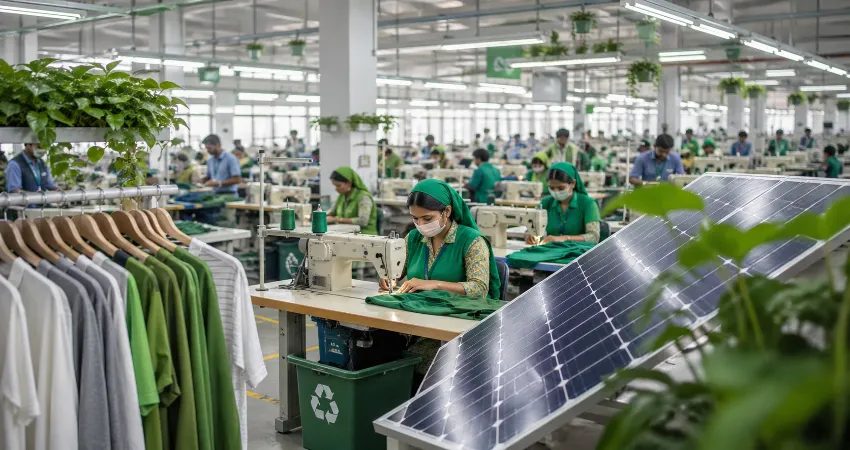
When global fashion brands talk about ethical sourcing, the conversation almost always points back to one country: Bangladesh. The nation’s garment sector has spent the better part of a decade rebuilding its reputation — and the results speak for themselves.
By the close of 2025, Bangladesh had reached a total of 268 LEED-certified apparel factories, a figure that no other country on earth comes close to matching. Among those, 114 carry the highest Platinum classification, and 68 appear in the worldwide top 100 ranking published by the US Green Building Council. In a single year — 2025 — the sector added 38 new certified facilities, the highest annual count ever recorded.
This matters deeply for international buyers. Brands operating in European and North American markets now face tightening environmental expectations from regulators, investors, and consumers alike.
A factory’s LEED score has gone from a nice credential to a practical sourcing filter — affecting long-term contracts, pricing conversations, and access to green financing instruments. Dhaka and its surrounding districts are where the highest concentration of these certified facilities sits.
This guide profiles the ten most important sustainable garment manufacturers in and around Dhaka that ethical sourcing teams should know, understand, and consider.
1. SM Sourcing — The World’s Highest-Rated Green Garment Factory
Located in Konabari, Gazipur — within Dhaka Division — SM Sourcing holds a distinction that no other apparel manufacturer anywhere in the world can claim: the highest LEED score ever recorded for a garment facility, at 106 out of a possible 110 points. What makes this achievement more remarkable is the factory’s scale.
SM Sourcing employs roughly 900 workers, making it a modest operation by Bangladeshi industry standards. Yet despite its size, the facility has integrated passive cooling architecture so effectively that its production floors remain comfortable even during peak summer heat — without relying on conventional air conditioning systems.
Rainwater harvesting is built into the core infrastructure, and energy efficiency runs through every system in the building. For sourcing teams prioritizing environmental credentials above all else, SM Sourcing sets the global benchmark.
2. Pakiza Knit Composite Limited — LEED Platinum in Savar
Pakiza Knit Composite Limited, based in Savar, earned LEED Platinum certification in October 2025 with a score of 87 points under the Operations and Maintenance rating system for existing buildings. The facility’s certification was part of a wave of five factories that pushed Bangladesh’s total certified count to 268.
Savar’s proximity to Dhaka city makes Pakiza Knit a particularly accessible partner for buyers arranging factory visits or logistics coordination through the capital.
Its certification under the O+M track — which evaluates how an existing building is actually operated, not just how it was constructed — signals a genuine commitment to ongoing environmental performance rather than one-time construction compliance.
3. Fashion Pulse Limited — Platinum New Construction in the Dhaka Industrial Belt
Fashion Pulse Limited earned LEED Platinum classification through the New Construction and Major Renovation pathway, scoring 87 points. The facility sits within the BSCIC Industrial Estate in Dhaka — a location that places it well within the city’s organized industrial infrastructure.
Factories certified under the New Construction pathway are evaluated during the design and build phase, which typically means the sustainability features are structurally embedded rather than retrofitted.
For buyers focused on supply chain transparency and environmental accountability from the ground up, Fashion Pulse represents the kind of intentional, purpose-built green factory that defines Bangladesh’s most forward-looking manufacturers.
4. GAVA Private Limited — Platinum Score in the Heart of Dhaka
GAVA Private Limited secured LEED Platinum status under the New Construction framework with 87 points, with its registered address located in Dhaka. Its certification, announced alongside Fashion Pulse and Pakiza Knit in October 2025, positions it firmly among Bangladesh’s most environmentally advanced manufacturers.
GAVA’s Platinum rating places it in a cohort where energy-efficient lighting, water recycling systems, and responsible construction material choices are standard — not exceptions.
Buyers sourcing from Dhaka-based facilities and prioritizing a verifiable environmental record will find GAVA’s credentials among the most current and credible available in the metropolitan area.
5. Consist Apparels — Platinum Factory in Gazipur’s Bawpara
Consist Apparels made headlines in January 2025 when it achieved LEED Platinum status with a score of 84 out of 100, pushing Bangladesh’s national total to 233 certified factories at that time. Located in Bawpara, Kaultiya under Gazipur District — a short drive from central Dhaka — Consist Apparels is a strong option for buyers who want Platinum-certified manufacturing within easy reach of the capital’s logistics infrastructure.
The Gazipur corridor has emerged as perhaps the densest concentration of green apparel factories anywhere in the world, and Consist Apparels is one of its most recently certified and therefore most up-to-date facilities in terms of environmental systems.
6. Sepal Garments Ltd — Gazipur Platinum with 85 Points
Sepal Garments Ltd, located in Chhaydana along the Degarchala Road in Gazipur, achieved LEED Platinum certification with an impressive score of 85 points. The factory’s address places it within a district that has become something of a global benchmark for green industrial development in the apparel sector.
Sepal Garments brings together the energy efficiency benchmarks, water stewardship systems, and indoor environmental quality standards expected of a top-tier Platinum facility, making it a credible and verifiable partner for brands operating responsible sourcing programs in the Dhaka metropolitan region.
7. Sumi Apparels Pvt. Ltd. — Registered LEED New Construction in Tongi and Gazipur
Sumi Apparels Pvt. Ltd. appears in the USGBC’s Green Building Information Gateway with facilities registered under LEED v4 New Construction in both Tongi and Gazipur District, covering over 160,000 square feet of industrial manufacturing space.
Registration under LEED v4 New Construction represents an active pipeline of green credentials — indicating the company is building to internationally certified standards rather than pursuing retrofits.
For sourcing teams looking to identify factories investing in the next generation of environmental performance, Sumi Apparels signals forward planning and commitment to sustainable infrastructure development within the Dhaka Division manufacturing corridor.
8. Ecotrims Bangladesh Ltd. — Certified Trim Supplier Supporting Sustainable Supply Chains
Ecotrims Bangladesh Ltd., based in Dhaka, appears in the USGBC’s certified building database with multiple registered facilities. While the company operates as a trim and accessory supplier rather than a finished garment manufacturer, its LEED credentials matter significantly to ethical sourcing teams.
The sustainability of a finished garment depends not only on the factory that assembles it but on every component supplier in the chain — buttons, labels, zippers, and trims all carry their own environmental footprints.
A LEED-registered trim supplier in Dhaka reduces that footprint at the component level, making Ecotrims a relevant partner for brands pursuing supply chain-wide sustainability rather than factory-only compliance.
9. HAMS Garments Ltd. — Green Manufacturing in Mawna, Dhaka Division
HAMS Garments Ltd., located in Mawna within Dhaka Division, carries LEED certification and appears in USGBC’s active building registry. The Mawna area, situated northeast of Dhaka, has attracted a growing number of green manufacturers as the city’s industrial belt expands beyond its traditional core districts.
HAMS Garments represents the kind of mid-sized, certified manufacturer that fills an important gap in the ethical sourcing landscape — providing green credentials and ethical production capacity at a scale accessible to brands that need reliable partner factories but are not always able to contract with the largest Platinum-rated facilities exclusively.
10. Denim Expert Limited — ESG Leadership and Multi-Framework Compliance
Denim Expert Limited, whose additional managing director Mohiuddin Rubel also serves as managing director of the Bangladesh Apparel Exchange, sits at an interesting intersection of manufacturing excellence and industry advocacy.
The company is a regular point of reference in discussions about Bangladesh’s green garment progress, and it operates with a multi-framework approach to sustainability that goes beyond the physical building. This means combining environmental certification with worker welfare audits, ESG reporting aligned with international investor expectations, and transparency mechanisms such as the Higg Index and Sedex frameworks.
For buyers whose sourcing programs require both environmental and social accountability — and who face mandatory ESG disclosure requirements from their own regulators — Denim Expert represents the most complete approach to ethical manufacturing available in the Dhaka region.
What Bangladesh’s Green Factory Leadership Means for Ethical Buyers?
The scale of what Bangladesh has built is genuinely difficult to appreciate from a distance. No other apparel manufacturing country comes close to matching 268 LEED-certified factories, 68 of which rank among the world’s top 100 highest-scoring green facilities.
The sector generated approximately $39.35 billion in export revenue during 2024–25, employs between 4.4 and 5 million workers, and supports the livelihoods of close to 20 million people — the majority of them women.
That economic weight, combined with the environmental credentials now embedded across hundreds of factories in Dhaka and its surrounding districts, makes Bangladesh the most compelling single-country sourcing destination for brands navigating the intersection of scale, cost competitiveness, and verified sustainability performance.
Certification under frameworks such as WRAP, SA8000, Sedex, Amfori BSCI, ZDHC, and the Higg Index adds the social dimension that LEED alone does not fully address.
Buyers building serious ethical sourcing programs in 2026 should look for factories carrying both environmental and social credentials — and Bangladesh’s leading manufacturers increasingly offer exactly that combination.
FAQs About Best Sustainable Garment Factories In Dhaka
1. Why does Bangladesh have more LEED-certified garment factories than any other country?
A combination of factors drove this: industry investment following the post-Rana Plaza rebuilding period, strong BGMEA advocacy for green standards, and the competitive advantage that certified factories gain in securing long-term contracts with international brands. Building a Platinum-rated facility costs roughly 40% more than a standard factory, but the commercial return — through better sourcing access and green financing — makes that investment increasingly viable for ambitious manufacturers.
2. Is LEED certification enough to guarantee ethical sourcing from a Dhaka factory?
Not on its own. LEED evaluates environmental performance — energy, water, and building quality — but does not assess labor practices or worker welfare. Ethical sourcing requires pairing LEED credentials with audits under social frameworks such as SA8000, Sedex, Amfori BSCI, or the Higg Index. Factories combining both environmental and social certifications offer the most complete guarantee for buyers with comprehensive responsible sourcing commitments.
3. What is LEED Platinum and how hard is it to achieve?
LEED Platinum is the highest classification under the US Green Building Council’s environmental rating system, requiring more than 80 points out of 110. It demands measurable achievement across energy efficiency, water management, materials sourcing, indoor environmental quality, and site sustainability. As of late 2025, Bangladesh has 114 Platinum-certified garment factories — the largest national concentration of this certification level in the world’s apparel manufacturing sector by a wide margin.
4. How do I verify a Dhaka garment factory’s sustainability credentials before sourcing?
The US Green Building Council’s Green Building Information Gateway (GBIG) at gbig.org provides a publicly searchable database of all LEED-certified and registered facilities worldwide, including Bangladesh. Cross-referencing a factory’s claimed certification against this database takes minutes and requires no login. For social audits, platforms like Sedex and Amfori BSCI maintain their own supplier databases that sourcing teams can access through membership.
5. Are sustainable garment factories in Dhaka significantly more expensive to source from?
Not necessarily more expensive per unit. Green factories typically achieve meaningful reductions in energy and water costs that offset some of the higher construction investment over time. The commercial reality is that certified factories often offer better quality consistency, lower defect rates, and longer partnership stability — factors that reduce hidden sourcing costs. Many global brands report that their certified supplier relationships deliver comparable or better total cost of ownership compared to uncertified alternatives at similar production scale.
Conclusion
Dhaka’s garment manufacturing landscape in 2026 is genuinely different from what it was a decade ago. The factories profiled here — from SM Sourcing’s record-breaking 106-point LEED score to Denim Expert’s multi-framework ESG approach — represent an industry that has chosen to compete on sustainability credentials rather than simply on price.
For international brands under growing regulatory and consumer pressure to demonstrate responsible sourcing, that choice creates real opportunity. Bangladesh now offers a combination that few manufacturing regions anywhere can match: certified environmental performance at scale, competitive production economics, deep sector experience, and an increasingly robust framework of social compliance.
Finding the right factory partner in Dhaka is no longer simply about capacity and cost — it is about finding a manufacturer whose credentials align with where global fashion is heading.