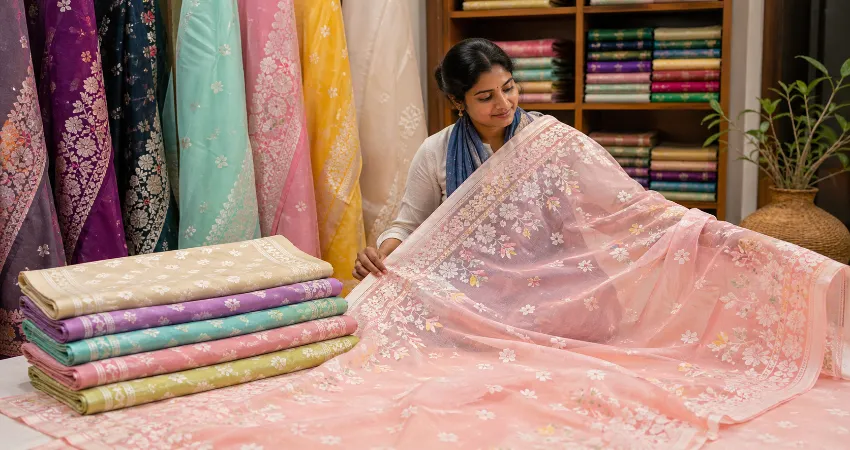
Rajshahi silk carries one of the oldest and most prestigious textile histories in South Asia. Records trace silk production in this northwestern Bangladesh region back to the 13th century, when it circulated under the name Bengal silk or Ganges silk among traders across the subcontinent.
The fabric earned its reputation through the specific qualities that genuine Rajshahi mulberry silk produces — a lustre, softness, and drape that weavers working with imported yarn simply cannot replicate. In 2021 the Bangladeshi government awarded Rajshahi silk official Geographical Indication status, placing it alongside the country’s most protected heritage products.
However, any international buyer approaching Rajshahi silk in 2026 needs to understand a critical market reality: most products currently sold under the Rajshahi silk name do not use locally produced silk yarn.
According to reporting by Bangladesh Sangbad Sangstha in March 2026, approximately 350 tonnes of yarn must be imported annually from China and India to meet domestic demand, while local production from silkworm cocoons reaches only around four tonnes of fine yarn per year — a fraction of what the sector requires.
Of the roughly 20 factories operating in Rajshahi’s BSCIC industrial estate, most weave fabric from imported yarn rather than domestically produced silk thread. Luxury fabric buyers seeking genuinely authentic Rajshahi silk must navigate this market carefully. This guide identifies the five most important sources to know.
1. Bangladesh Sericulture Development Board (BSDB) — The Only Guaranteed Cocoon-Origin Silk Source
The Bangladesh Sericulture Development Board is the single most important source for luxury buyers who require genuinely authentic Rajshahi silk — fabric woven from thread extracted directly from locally raised silkworm cocoons rather than imported yarn.
Arifa Sultana, the Board’s Chief Production and Marketing Officer, confirmed in March 2026 that while their output is limited, every product they sell is made from pure silk. The Board oversees the government silk factory, 11 of the country’s 16 mulberry nurseries, and research operations through the Bangladesh Sericulture Research and Training Institute in Rajshahi.
For buyers who cannot compromise on authentic origin — whether for premium retail positioning, luxury fashion sourcing, or heritage textile collection — the BSDB is the only source that provides a verifiable guarantee. Premium silk sarees from this source command prices above comparable market alternatives, which reflects the genuine material quality rather than marketing positioning.
2. Sopura Silk Mills Limited — Rajshahi’s Largest Private Silk Showroom
Sopura Silk Mills Limited operates what is widely recognized as the largest private silk showroom in Rajshahi city. Its retail and wholesale presence makes it the most commercially significant private-sector name in the regional silk trade for both domestic and visiting international buyers.
The critical caveat that luxury buyers must hold in mind: a customer at Sopura’s showroom told BSS journalists in March 2026 that she was unaware the garments sold there were made from yarn imported from India and China rather than locally produced silk. Sopura’s product range covers saris, panjabis, sherwanis, scarves, and three-piece outfits across wide price points — from everyday grades to premium presentation pieces.
For buyers seeking wide variety and established commercial relationships, Sopura is the primary private-sector contact point in Rajshahi. For buyers who specifically require cocoon-origin silk, direct conversation with Sopura about their sourcing is essential before ordering.
3. BSCIC Industrial Estate Weavers — The Craft Cluster for Authentic Artisan Production
The Bangladesh Small and Cottage Industries Corporation (BSCIC) industrial estate in Rajshahi houses approximately 20 silk weaving factories — the most geographically concentrated cluster of silk production capability in the country.
While the majority of these operations currently source imported yarn due to the economics of local silk production, a subset of smaller artisan weavers within and adjacent to this estate still maintain traditional weaving techniques passed down through generations.
For design-focused luxury buyers and fashion brands seeking limited-edition artisan fabric production — where the weave quality and pattern complexity matter more than strict yarn origin — the BSCIC estate represents the deepest concentration of technical weaving skill available in Bangladesh.
Buyers should approach the estate through official BSCIC channels or the Bangladesh Silk Industry Owners Association for vetted artisan contacts.
4. Bangladesh Silk Industry Owners Association — Gateway to Verified Producer Networks
The Bangladesh Silk Industry Owners Association, whose president Md Liaquat Ali has been actively engaged in public advocacy for the sector’s recovery in 2025 and 2026, serves as the most important institutional gateway for international buyers who want to identify and vet multiple producers rather than approaching the market one factory at a time.
The Association represents private producers, showroom operators, and yarn traders across the Rajshahi silk cluster, and engagement through this body provides buyers with both an overview of current production capabilities and direct introductions to member producers.
You May Like: Top 10 Best Authentic Jamdani Saree Vendors For Global Shipping
For sourcing teams building medium to long-term supply relationships in the Rajshahi silk sector — particularly as government support for sericulture expansion materialises — the Association is the practical starting point for any serious market-entry process.
5. Aarong (BRAC) — Curated Authentic Silk with Fair-Trade Certification and International Shipping
For international luxury fabric buyers who cannot travel to Rajshahi directly or who want the assurance of fair-trade verification alongside their authentic silk sourcing, Aarong — the retail arm of BRAC — provides the most accessible and accountable route to genuine Bangladeshi silk products.
Aarong’s sourcing model works directly with artisan communities, its quality control is among the most consistent of any Bangladeshi heritage textile retailer, and its online platform ships internationally. Its Rajshahi silk sarees, scarves, and fabric lengths are curated for quality and authenticity with artisan welfare embedded in the supply chain.
For premium buyers in North America, Europe, or East Asia who want verified Rajshahi silk without the complexity of direct factory sourcing from Bangladesh, Aarong is the single most practical international-access option currently available.
FAQs About Best Rajshahi Silk Producers For Luxury Fabric Buyers
1. Is most silk sold in Rajshahi genuinely made from local silk?
No. As of March 2026, local cocoon-based silk production meets only about one percent of the yarn demand. The rest is imported from China and India. Only the Bangladesh Sericulture Development Board guarantees fully cocoon-origin silk in every product it sells.
2. What price range should luxury buyers expect for authentic Rajshahi silk?
Average-quality saris sell for around $100, while premium pieces exceed $250 in the local market. Prices at the government BSDB sales centre tend to run slightly higher than private showrooms, reflecting the genuine cocoon-origin yarn rather than imported alternatives. International shipping and import duties add to the final landed cost.
3. What types of silk does Rajshahi produce?
Two main types: mulberry silk (from Bombyx mori silkworms fed on fresh mulberry leaves) and non-mulberry varieties including eri silk. Mulberry silk — sometimes called Bengal silk — is the more prized of the two and historically the foundation of Rajshahi’s international reputation.
4. Does Rajshahi silk have Geographical Indication status?
Yes. Rajshahi silk received GI recognition in 2021. However, GI status does not currently prevent producers from labelling imported-yarn products as Rajshahi silk — a gap that industry leaders are actively lobbying the government to address through stricter enforcement.
5. Can I source Rajshahi silk for export without travelling to Bangladesh?
Yes. Aarong ships internationally with fair-trade verified sourcing. For larger wholesale volumes, engagement through the Bangladesh Silk Industry Owners Association or direct correspondence with the Bangladesh Sericulture Development Board is the most practical remote-sourcing route.
Conclusion
Rajshahi silk in 2026 is a luxury textile category that rewards buyers who do their homework before purchasing. The Bangladesh Sericulture Development Board is the only source that guarantees cocoon-origin silk in every product. Sopura provides the widest private-sector product range with the caveat of imported yarn.
The BSCIC estate holds the deepest artisan weaving skill. The Bangladesh Silk Industry Owners Association provides vetted producer access. And Aarong offers international buyers an accountable, fair-trade verified route to genuine Rajshahi silk without requiring direct factory engagement.
Understanding these distinctions is what separates a luxury sourcing relationship built on authentic provenance from one built on a label alone.