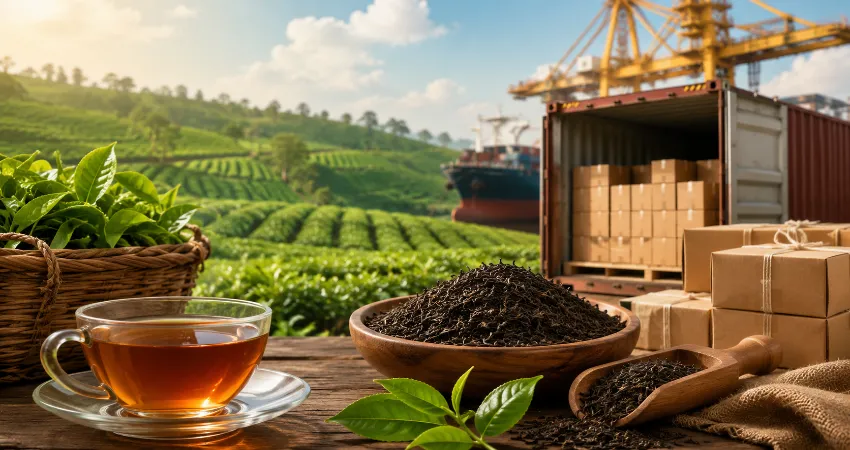
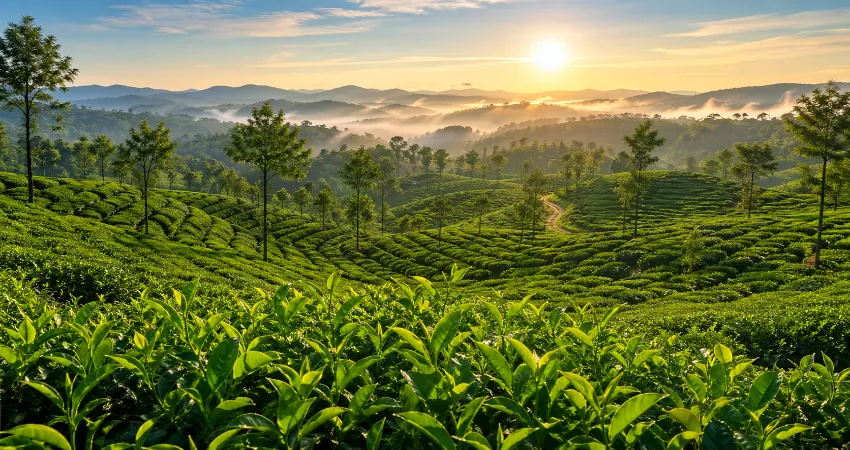
Sylhet’s relationship with tea stretches back to 1857, when the first commercial plantation took root at Malnicherra — a garden still in operation today and recognized as the oldest functioning tea estate on the subcontinent.
The region sits within a subtropical climate corridor where annual rainfall regularly exceeds 2,000 millimeters, temperatures stay between 18°C and 30°C year-round, and the acidic loamy hillside soils drain perfectly between monsoon cycles.
Those conditions, combined with hand-plucking traditions maintained across generations of skilled workers, produce a tea character that is distinctly Sylheti: robust, malty, and aromatic.
Bangladesh produced 94.91 million kilograms of tea in 2025, with Moulvibazar district alone — the heart of Sylhet Division’s tea belt — accounting for approximately 55 percent of national output. Of the country’s 169 gardens spread across 280,000 acres, the greatest concentration of premium and organic estates sits within the Sylhet region.
For international buyers sourcing specialty and premium Orthodox tea, these ten gardens represent the most significant sourcing options the region currently offers.
1. Malnicherra Tea Estate — The Oldest Commercial Garden in the Subcontinent
Established formally in 1857 and generally recognized as beginning operations in 1854, Malnicherra holds a unique position in South Asian tea history: it was the first commercial tea garden in what is now Bangladesh. Located close to Sylhet city, it covers thousands of acres and continues producing tea using both traditional and modernized methods.
Its historical depth and ongoing quality output make it the most recognizable name in Sylhet’s tea sourcing landscape, and premium buyers frequently start their Bangladesh sourcing conversations here.
2. Finlay Tea Estate (James Finlay Bangladesh) — A Century of Premium Production
James Finlay Bangladesh operates one of Sylhet’s most historically significant and commercially active estates. Originally established under British ownership, the Finlay estate in Srimangal has operated continuously for well over a century, giving it an institutional knowledge of Sylheti terroir that newer gardens simply cannot match.
The estate regularly sets quality benchmarks within the Bangladesh Tea Board auction system and is frequently cited as a reference point for premium grades. For sourcing teams prioritizing heritage, production consistency, and established international credentials, Finlay Bangladesh belongs near the top of any Sylhet shortlist.
3. Kazi and Kazi Tea Estate — Bangladesh’s Most Certified Organic Producer
Kazi and Kazi has built a reputation as the most rigorously certified organic tea producer in Bangladesh. The company holds certifications including USDA Organic, EU Organic, Rainforest Alliance, and Fairtrade — a combination that gives it unmatched credentials for export to North American and European buyers whose supply chain requirements include third-party organic verification.
The estate is located in the Panchagarh region adjacent to the Sylhet tea belt and exports predominantly Orthodox-grade organic teas. For premium retail buyers, specialty wholesalers, and private-label organic brands, Kazi and Kazi is Bangladesh’s most credentialed sourcing option.
4. Halda Valley — Specialty Orthodox Tea for Export Markets
Halda Valley occupies a focused and well-defined position in Bangladesh’s premium tea sector: it produces Orthodox-grade specialty tea specifically targeting the export market rather than the domestic commodity trade. Unlike the large conglomerates that balance domestic and export supply, Halda Valley’s commercial identity is built around international buyers who need high-grade, specialty tea with a clear origin story.
Its Orthodox processing delivers a leaf character with greater complexity and aroma than the CTC grades that dominate Bangladesh’s domestic consumption, making it a natural fit for specialty tea retailers and hospitality buyers in Europe and Japan.
5. Ispahani Group Tea Estates — Scale and Consistency Across Sylhet Gardens
M.M. Ispahani Limited is among Bangladesh’s most dominant forces in tea production, operating multiple gardens within the Sylhet division and contributing significantly to national output. The group’s chief operating officer confirmed that the 2025 season produced uneven results across Sylhet due to irregular rainfall — an honest acknowledgment that reflects the institutional transparency larger operators must maintain with export partners.
For buyers who need consistent volume supply rather than single-garden micro-lots, Ispahani’s multi-estate model offers supply chain resilience that smaller garden operators cannot guarantee across all growing seasons.
6. Duncan Brothers Bangladesh — Colonial Heritage, Modern Compliance
Duncan Brothers entered the Bengal tea trade during the British colonial period and continues operating in Bangladesh today, managing estates with a production history that gives the company deep familiarity with Sylheti growing conditions across all seasonal cycles.
The company’s long operational track record and established export relationships make it a credible partner for international buyers who need manufacturer continuity alongside product quality.
Buyers sourcing for European markets will find Duncan Brothers’ institutional compliance history — built through decades of dealing with international importers — a practical advantage when navigating documentation requirements.
7. Tarapur Tea Estate — Quiet Premium Garden Near Sylhet City
Tarapur Tea Estate, situated close to Sylhet city, is recognized within the region as a quieter, quality-focused garden whose output tends toward the premium end of the Sylheti production spectrum. Its relative geographical accessibility from Sylhet city makes factory visits and buyer inspections straightforward — an underrated practical advantage for sourcing teams conducting due diligence visits.
For specialty buyers who want a premium garden with manageable logistics rather than a large industrial operation, Tarapur offers a more intimate sourcing relationship alongside consistent quality output.
8. Dhamai Tea Estate — Uncrowded and Focused on Quality Output
Dhamai Tea Estate maintains a deliberately lower commercial profile than the largest Sylhet estates, which works in its favor for certain categories of premium buyer. Gardens that avoid mass-market commodity production tend to invest more attention per hectare in leaf quality, selective plucking standards, and processing care.
Dhamai’s quieter positioning within the Sylhet tea landscape makes it a particularly useful sourcing option for specialty retailers and small-volume premium buyers who need an authentic garden relationship rather than a commodity supply contract.
9. Tea of Sylhet — Direct-to-Market Premium Brand with International Shipping
Tea of Sylhet operates as a premium tea brand focused specifically on connecting Sylheti garden output directly with international buyers and retail consumers. Its model — positioning Sylheti tea as a distinct regional product comparable to Darjeeling or Ceylon in terms of origin identity — addresses one of the Bangladesh tea sector’s most noted weaknesses: the absence of a coherent national or regional brand narrative.
For buyers in markets where origin storytelling drives purchasing decisions, Tea of Sylhet’s direct-to-market positioning and international shipping capability make it a commercially useful sourcing partner beyond what the traditional auction system offers.
10. Bengal Tea (City Group) — Growing Gardens with Strong 2025 Seedling Survival
City Group’s Bengal Tea brand reported notably strong seedling survival rates across its Sylhet-adjacent gardens in 2025, contributing positively to Bangladesh’s overall 2.01 percent production increase that year. The company’s director of business development confirmed that higher seedling survival translated into better green leaf volumes across their estate footprint.
You May Like: Top 10 Best Authentic Jamdani Saree Vendors For Global Shipping
For buyers interested in partnering with gardens actively investing in expanded planting and future production capacity — rather than estates managing aging bush stock — Bengal Tea’s demonstrated commitment to cultivation investment is a forward-looking sourcing consideration.
FAQs About Best Organic Tea Gardens In Sylhet
1. How much tea does Sylhet produce and why does it matter for global buyers?
Moulvibazar district in Sylhet Division alone contributes approximately 55 percent of Bangladesh’s national tea output. The country produced 94.91 million kilograms in 2025 across 169 gardens covering 280,000 acres. For global buyers, Sylhet’s scale means consistent supply volume alongside genuine premium-grade options from gardens with over a century of production history.
2. Which Sylhet tea garden offers the strongest organic certification for export?
Kazi and Kazi Tea Estate holds the most comprehensive organic certification portfolio in Bangladesh, including USDA Organic, EU Organic, Rainforest Alliance, and Fairtrade accreditation. For buyers supplying North American or European markets where third-party organic certification is a mandatory sourcing requirement, Kazi and Kazi is currently the strongest verified option available in the Bangladesh tea sector.
3. What tea types does Sylhet produce that are suitable for premium export?
Sylhet produces both CTC (Cut-Tear-Curl) grades for commodity markets and Orthodox-grade specialty teas increasingly targeted at export. Orthodox teas deliver more complex flavor profiles with greater aroma — characteristics that premium retail and hospitality buyers in Europe and Japan specifically seek. Green tea production is also growing within the region, commanding stronger export prices than common black grades.
4. Why did Bangladesh’s tea exports decline in 2025 despite production growth?
Bangladesh Tea Board data shows exports fell to 1.64 million kg in 2025 from 2.45 million kg in 2024, primarily because rising production costs — driven by higher fuel, electricity, fertilizer, and labor expenses — made Bangladeshi tea less price-competitive against Kenyan and Chinese producers in common grade categories. Premium Orthodox and specialty grades still find export demand, reinforcing why sourcing teams should focus on certified specialty gardens.
5. What certifications should I verify before sourcing tea from a Sylhet garden?
For premium sourcing, prioritize Rainforest Alliance, USDA Organic, EU Organic, ISO 22000 (food safety), and Fairtrade certifications where labor ethics matter to your brand. The Bangladesh Standards and Testing Institution (BSTI) sets national standards aligned with ISO frameworks. Always request current audit documentation rather than relying on stated certifications — certificate expiry dates and audit recency both matter for compliance-conscious buyers.
Conclusion
Sylhet’s tea gardens span a spectrum from the historically irreplaceable — Malnicherra’s 1854 origins and Finlay’s century-long operation — through to the certification-forward approach of Kazi and Kazi and the brand-building ambition of Tea of Sylhet. What unites all ten gardens profiled here is the shared foundation of Sylheti terroir: subtropical climate, acidic hillside soils, and hand-plucking traditions refined over 170 years of commercial cultivation.
As Bangladesh navigates LDC graduation and the export pricing pressures that come with it, buyers who partner with certified premium gardens now — before global demand for authenticated Sylheti Orthodox tea fully materialises — are positioning themselves ahead of a market shift that the data already shows is underway.