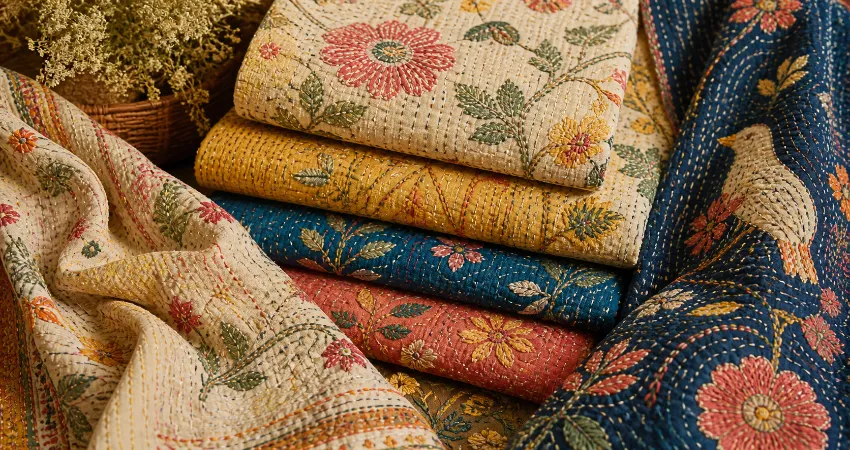
Nakshi Kantha is one of the most enduring art forms in South Asian textile history — a quilted embroidery tradition rooted in Bengal that predates the Mughal Empire and has survived every political rupture the region has experienced since. The name comes directly from Bengali: nakshi meaning artistic patterns, and kantha meaning quilt or covering.
For centuries, rural women across what is now Bangladesh created these stitched narratives from recycled layers of worn cotton saris, transforming discarded cloth into objects of striking beauty. In 2024, Bangladesh received Geographical Indication recognition for Jamalpur Nakshikantha — a formal global acknowledgment of what communities here have always known: this craft belongs to this land.
Today, Nakshi Kantha occupies a genuinely different market position than it did even a decade ago. Interior design trends, the global appetite for artisan textiles, and the growth of ethical sourcing have brought it into boutiques, museums, and fashion collections across Europe, North America, and Japan.
For buyers in 2026, the design question matters as much as the sourcing question. These ten traditional Nakshi Kantha design categories represent the most significant and commercially relevant patterns for buyers seeking authentic pieces.
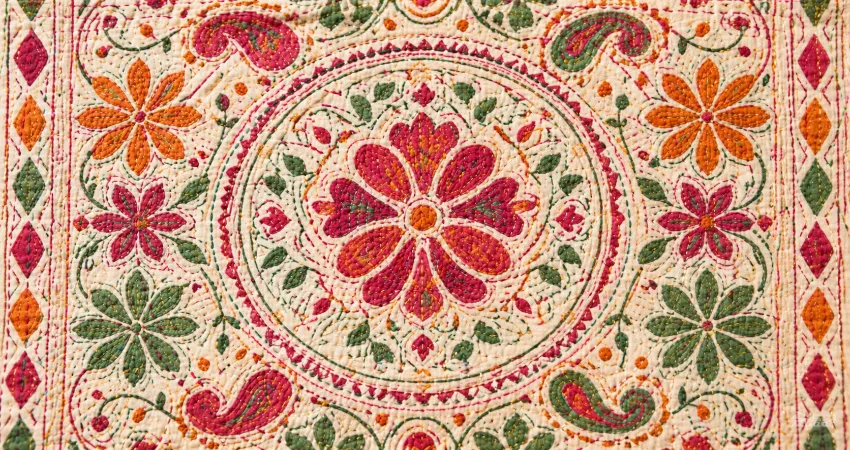
1. The Lotus Mandala (Shapat Padma) — The Defining Nakshi Kantha Motif
No design is more central to the Nakshi Kantha tradition than the lotus mandala placed at the centre of a quilt, with tree-of-life motifs anchoring each corner. The lotus carries layered significance across Hindu, Buddhist, and Islamic traditions — which is precisely why it became the unifying symbol of Bengali folk art across religious communities.
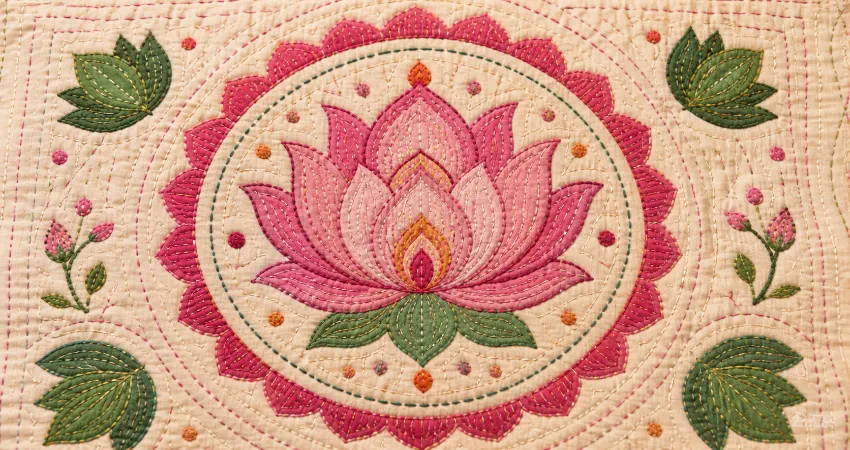
A fully realized lotus mandala piece represents weeks or months of careful stitchwork and remains the benchmark against which all other Nakshi Kantha designs are judged. For buyers seeking a single representative piece of the tradition, this is it.
2. Rajshahi Lahori Kantha — Wave Patterns with Regional Distinctiveness
The Lahori kantha originating from the Rajshahi region is immediately distinctive for its wavy, flowing line patterns that create movement across the entire surface of the textile. Within the Lahori family, three sub-patterns exist: soja (straight lines), kupi (triangle formations), and barfi (diamond arrangements).
This geometric discipline, combined with Rajshahi’s strong tradition of weaving and needlework, produces kanthas that read as abstract compositions to contemporary eyes while remaining deeply rooted in regional visual vocabulary. For interior design buyers, Lahori kanthas function exceptionally well as wall hangings.
3. Sujni Kantha — Vine, Leaf, and Floral Narrative Embroidery
Sujni kantha is the large-format narrative design category within the tradition — pieces where interconnected vines, leaves, and floral motifs create a flowing visual story across an expansive cloth. Because of its scale, sujni kantha demands the most time investment of any design type, often requiring multiple women working together on a single piece.
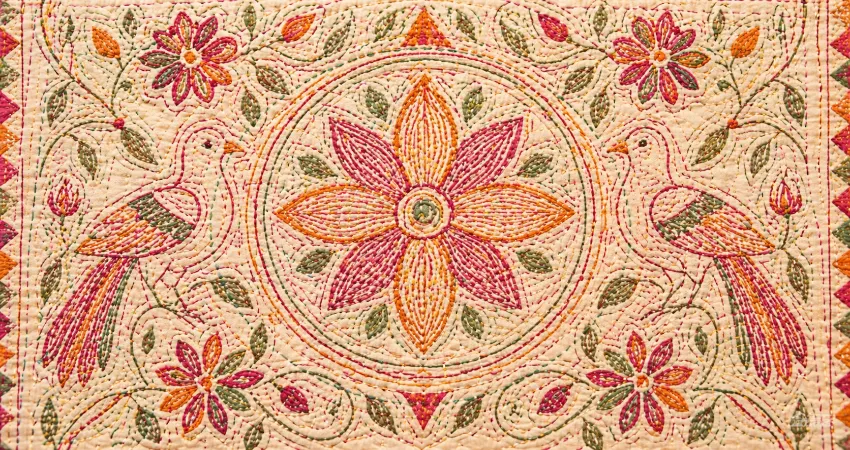
This collaborative production method is itself part of the textile’s cultural value. For buyers seeking ceremonial pieces, gifts of genuine significance, or statement home textiles that reward close examination, sujni kantha is the design category that delivers the most visual depth.
4. Anarashi (Pineapple) Kantha — Jessore’s Geometric Signature
The Anarashi pattern — named for its visual resemblance to a pineapple’s surface geometry — originated in the Jessore area and spread across the Malda and Chapainawabganj districts. It was introduced during the British colonial period and became thoroughly absorbed into the regional folk tradition over generations.
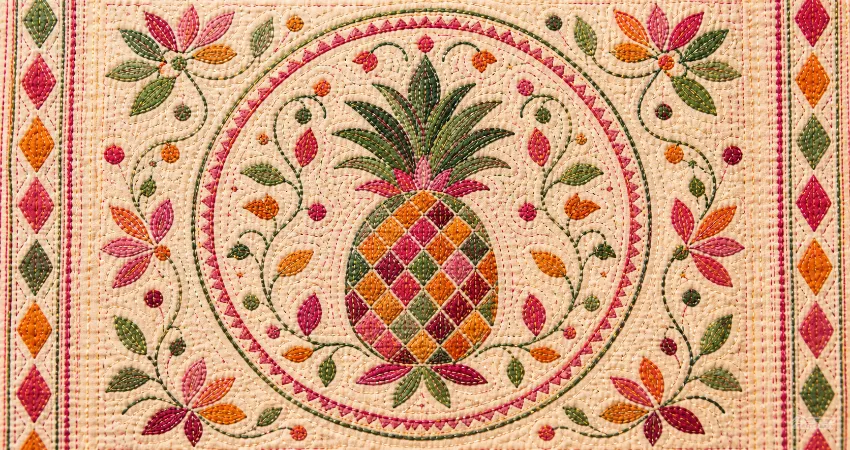
The pattern’s interlocking geometric cells create a remarkably contemporary aesthetic that resonates with buyers drawn to mid-century design references. Within the Anarashi family, variations include lik tan, lik tile, lik jhumka, and lik lohori — each with slightly different proportions and visual rhythm.
5. Jamdani-Influenced Islamic Motif Kantha — Mosque, Star, and Crescent Designs
A distinct branch of Nakshi Kantha draws from Islamic artistic heritage — incorporating mosque silhouettes, crescent moons accompanied by stars, and Arabic calligraphy into stitched compositions. These kanthas are particularly associated with jainamaz (prayer mat) use and covers for religious texts.
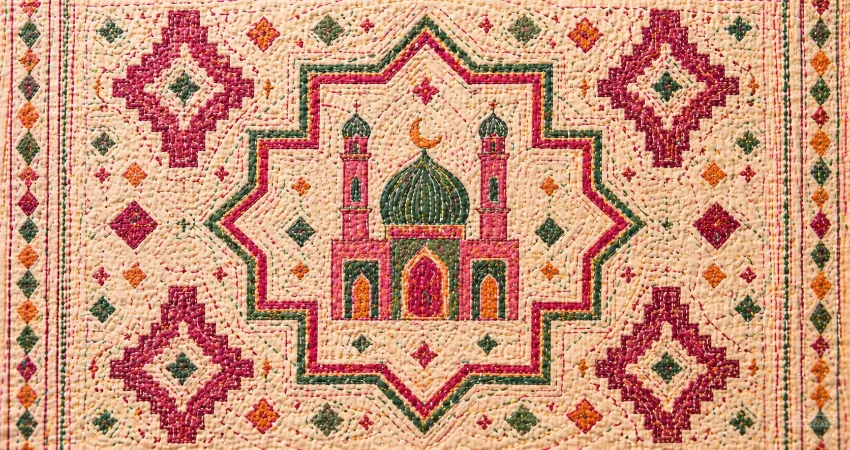
The moon and star motifs hold specific spiritual resonance in Bengali Muslim communities and appear most frequently in kanthas from districts with strong Muslim artisan traditions. For international buyers with an interest in the intersection of sacred and folk art, this design category offers genuinely unusual and meaningful pieces.
You May Like: Top 10 Best Authentic Jamdani Saree Vendors For Global Shipping
6. Rural Life Narrative Kantha — Birds, Fish, Boats, and Daily Scenes
Some of the most beloved Nakshi Kantha pieces are those that function as visual diaries — depicting birds perched on trees, fish moving through river currents, boats crossing water, village scenes, and domestic moments from rural Bengal.
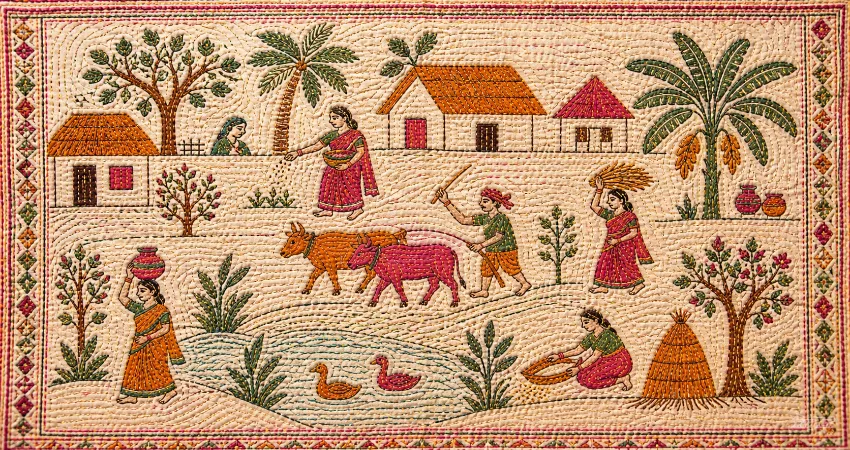
These narrative kanthas have roots in the tradition of 19th-century pieces now held in museum collections across Europe and North America. Contemporary artisans continue producing this style, and it consistently resonates with international buyers precisely because the imagery communicates across cultural boundaries without requiring any specialist knowledge of Bengali visual convention.
7. Tree of Life Corner Kantha — Symmetrical Sacred Geometry
Kanthas built around the tree-of-life motif at all four corners — with the lotus or a central mandala filling the middle — create a formal compositional symmetry that feels both ancient and completely resolved as a design. The tree of life symbol appears across cultures from Mesopotamia to Bengal, and in Nakshi Kantha it carries specific associations with fertility, continuity, and the connection between earth and sky.
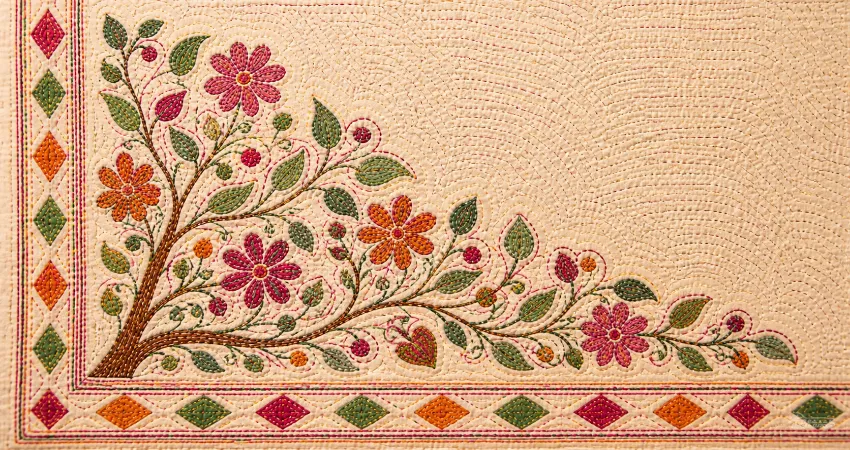
Pieces organized around this framework are among the most requested in international markets because their visual structure translates naturally into the format of a framed wall hanging or decorative throw.
8. Cross-Stitch Nakshi Kantha — Geometric Precision for Contemporary Buyers
While the running stitch is the foundational Nakshi Kantha technique, cross-stitch kanthas occupy a distinct and growing market position. The grid-based precision of cross-stitch lends itself to highly regular geometric patterns with sharp edges and consistent colour distribution — a visual quality that appeals to buyers whose aesthetic sensibility runs toward the Scandinavian or Japanese end of the design spectrum rather than the more fluid organic forms of traditional running-stitch work.
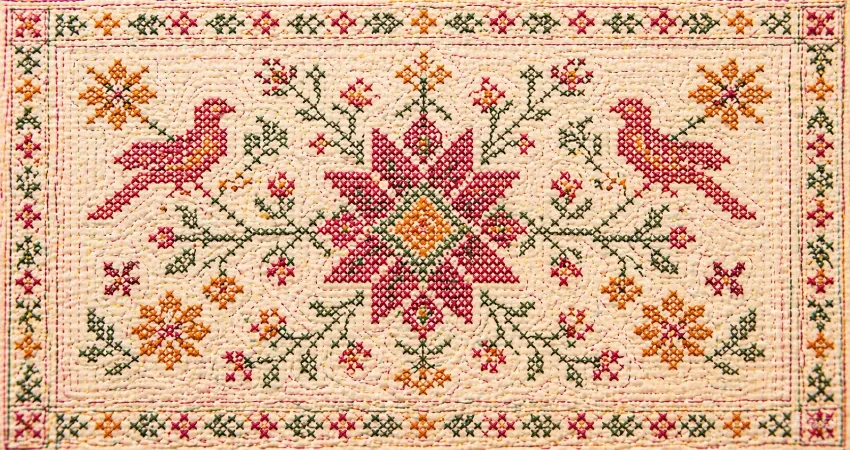
Cross-stitch kanthas from contemporary artisan cooperatives in Bangladesh are increasingly exported to design-forward retailers in Europe.
9. Nakshi Kantha Pillow Covers and Small Accessories — Entry-Level Authentic Pieces
For buyers who want to own and use authentic Nakshi Kantha embroidery without the investment required for a full quilt, pillow covers and small accessories represent the most accessible entry point. Stitched pillow covers, wallets, small bags, scarves, and handkerchiefs — known as naksi rumal in the traditional gifting context — carry the same design vocabulary and artisan skill as larger pieces but at proportional price points.
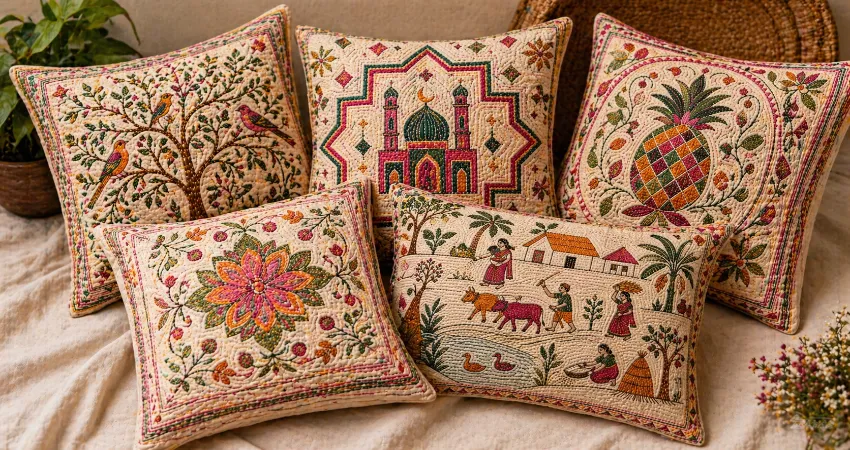
International platforms including Etsy and direct cooperative websites now ship these pieces globally, making the tradition genuinely accessible to buyers who encounter it for the first time through home decor and fashion channels.
10. Contemporary Fashion Nakshi Kantha — Traditional Stitch, Modern Silhouette
The most commercially dynamic evolution of the tradition in 2026 is the application of Nakshi Kantha stitching to contemporary fashion garments. Blazers, denim jackets, and scarves with kantha stitch detailing are being produced by Bangladeshi boutique labels and exported globally.
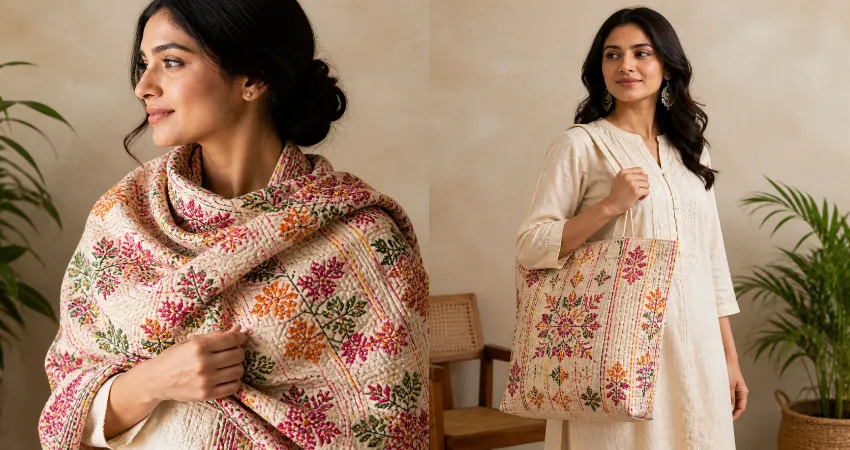
The Daily Star’s 2026 home decor feature specifically identified Nakshi Kantha as a material crossing from craft object into interior design staple, while fashion designers are integrating kantha stitching into garments that sit comfortably in both heritage and contemporary wardrobes.
For buyers sourcing for fashion retail rather than textile collecting, this is where the market’s growth is most concentrated.
FAQs About Best Traditional Nakshi Kantha Designs
1. What makes a Nakshi Kantha genuinely authentic versus a machine-made imitation?
Authentic Nakshi Kantha is always hand-stitched using the kantha running stitch — a technique that creates surface texture visible to the touch as well as the eye. The stitching should be visible on the reverse side. Machine-produced versions lack this texture variation and reverse-side character. Traditional pieces use two to five layers of recycled cotton cloth, and the motifs are created within the stitch rather than printed or appliquéd on top of a base fabric.
2. Which region of Bangladesh produces the most prized Nakshi Kantha today?
Jamalpur received Bangladesh’s first Geographical Indication recognition for Nakshikantha in 2024, making it the officially designated origin for the country’s most recognized kantha tradition. Rajshahi is also highly regarded for its Lahori and Sujni kantha styles. The Mymensingh, Jessore, and Faridpur districts each maintain distinct regional design vocabularies worth understanding before making sourcing decisions.
3. How long does it take a skilled artisan to complete a full Nakshi Kantha quilt?
A typical artisan spends three to six months completing a full-sized Nakshi Kantha with complex motifs. More elaborate ceremonial pieces — particularly large sujni kanthas with dense narrative embroidery — can take longer, sometimes requiring multiple artisans working together. This time investment is the primary factor determining price: any full quilt priced unusually low warrants careful authenticity verification.
4. Where can international buyers reliably purchase authentic Nakshi Kantha with global shipping?
Aarong (Bangladesh’s largest fair-trade artisan retailer) ships internationally and carries authenticated Nakshi Kantha pieces across multiple product categories. Etsy hosts verified sellers including ThreadsOfBengal and NewTextileHouse. Direct cooperative websites sourced through development organizations provide the most direct artisan-to-buyer chain. Always verify the seller’s sourcing description and look for fair-trade certification language before purchasing.
5. Is Nakshi Kantha suitable for home decor use or is it primarily a collector’s textile?
Both. The Daily Star’s 2026 home decor guide specifically recommends Nakshi Kantha as a wall hanging, sofa throw, and decorative bed cover for modern interiors. Smaller pieces — pillow covers, framed panels, and table runners — integrate naturally into contemporary home settings. Collector-grade pieces with museum-quality embroidery represent a separate market tier that sits alongside everyday decorative use rather than excluding it.
Conclusion
Nakshi Kantha in 2026 occupies a stronger global market position than at any previous point in its commercial history — driven by ethical sourcing trends, the growth of artisan textile collecting, and fashion’s embrace of traditional embroidery techniques.
From the foundational lotus mandala to the wave patterns of Rajshahi’s Lahori kantha, the narrative folk scenes of rural Bengal, and the contemporary fashion applications now reaching European boutiques, the tradition’s design vocabulary is both deep and adaptable.
Buyers who invest the time to understand regional distinctions and prioritize verified fair-trade sourcing will find Nakshi Kantha one of the most rewarding artisan textile categories available from South Asia in 2026.