Bangladesh is the world’s second-largest producer of jute — the golden fiber that has been woven into the country’s cultural and economic identity for centuries. Today, that same fiber is at the center of one of the most significant shifts in global home decor: the move toward sustainable, natural materials over synthetic alternatives. Jute cultivation exemplifies sustainable agriculture — this remarkable plant grows quickly in tropical regions, particularly Bangladesh and India, requiring minimal irrigation and few if any pesticides.
A single crop can be harvested up to three times annually, making it one of the most renewable natural fibres available. For eco-conscious homeowners looking to bring natural warmth, texture, and sustainability into their living spaces, jute rugs from Bangladesh represent one of the most compelling choices available in 2026.
The global market for natural fiber rugs is growing rapidly as consumers move away from synthetic materials that off-gas chemicals, end up in landfills, and carry a heavy environmental production footprint. The global jute bag and product market is expected to reach $3.2 billion by 2026, with Bangladesh’s jute exports increasing by 20% annually.
This guide covers the ten best types and styles of eco-friendly jute rugs from Bangladesh for modern homes — what makes each distinctive, which spaces they suit best, and what to look for when choosing one.
1. Classic Handwoven Flatweave Jute Rug
The flatweave handwoven jute rug is the foundational style exported from Bangladesh — simple, durable, and naturally beautiful. The transformation from raw fibre to finished rug often happens through small-batch handweaving techniques. Skilled artisans work on traditional looms, carefully creating consistent textures while allowing for the natural variations that give each rug its unique character.
Flatweave jute rugs work exceptionally well in living rooms, dining areas, and open-plan spaces where you want natural texture without bulk. The tight weave makes them among the most durable of all jute styles and relatively easy to clean.
2. Braided Jute Area Rug — The Farmhouse Favorite
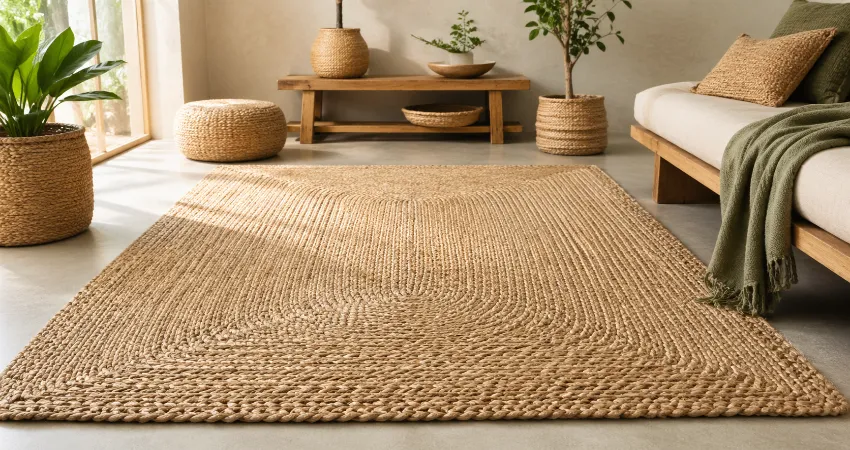
Braided jute rugs are one of Bangladesh’s most actively exported styles, with manufacturers like Dadabangla Natural Fiber Ltd. shipping braided flatweave and round braided options globally. The braiding technique creates a dense, layered texture that adds warmth and visual interest to any room.
In rugs, jute offers a rustic, organic aesthetic while providing durability and resilience, making it an excellent choice for eco-conscious consumers. Braided styles suit farmhouse, coastal, and Scandinavian-inspired interiors particularly well, and their reversibility extends their lifespan significantly.
3. Geometric Patterned Jute Rug — Contemporary Design Meets Tradition
Fair trade artisans in remote, rural communities of Bangladesh handmake geometric jute rugs — the women first weave jute shapes and then assemble the pattern, before stitching pieces together using needle and thread. The result is like a contemporary patchwork that adds warmth, texture and character.
Geometric patterned jute rugs bridge the gap between traditional handcraft and modern interior design aesthetics, making them among the most versatile Bangladesh jute exports for contemporary homes seeking a balance between sustainability and visual interest.
4. Jute and Wool Blend Rug — Softer and More Luxurious
Pure jute can feel rough underfoot — a common concern for bedroom use. The solution is a jute-wool blend, which combines jute’s structural sustainability with wool’s natural softness. Sabai’s Field Rug, for example, uses sustainably harvested jute from Bangladesh and ethically sourced wool from New Zealand and the UK — the two materials come together to make a naturally soft rug that adjusts to changes in body temperature, staying cool in summer and cozy in winter.
Jute-wool blends from Bangladesh are increasingly sought after by global retailers for bedroom and living room applications where comfort underfoot matters as much as sustainability credentials.
5. Naturally Dyed Jute Rug — Color Without Compromise
For homeowners who want color alongside natural materials, naturally dyed jute rugs from Bangladesh offer a compelling combination. Eco-friendly rugs use low-impact dyes and no harmful chemicals — and in most cases they are prepared using fair-trade certified labor that guarantees workers are treated ethically.
Natural dyes derived from plants, minerals, and other organic sources can produce a surprisingly wide range of colors — from warm terracottas and ochres to cooler sage greens and blues — while keeping the rug’s environmental credentials intact from fiber to finish.
6. Round Jute Rug — Ideal for Dining Rooms and Reading Nooks
Round jute rugs from Bangladesh have grown significantly in global export demand, with manufacturers offering sizes from small accent circles to large 8-foot rounds suitable for dining tables. The circular format softens angular modern interiors and creates natural focal points in any room.
Bangladesh exporters including Dadabangla Natural Fiber Ltd. and M/S. JF Trading International offer customizable round jute rugs in multiple sizes and weave patterns, making this an accessible format for both retail and interior design procurement at competitive price points.
7. Jute Runner Rug — Hallways and Kitchen Corridors
The jute runner is one of the most practical exports from Bangladesh’s jute rug industry — narrow, long, and designed for high-traffic corridors, kitchen runs, and hallway applications where durable natural fiber is needed without the bulk of a full area rug.
Technical specifications for commercial-grade jute runners should include fiber density of at least 1,200 GSM for commercial use, natural latex backing preferred over synthetics, and pile height under 0.5 inches for high-traffic areas. Runner rugs from Bangladesh are among the most price-competitive in the global natural fiber market.
8. Seagrass and Jute Combination Rug — Texture and Sustainability Combined
Seagrass is a renowned natural resource that grows naturally in Bangladesh’s coastal areas and wetlands. Its unique texture and strength make it a favorite material for crafting eco-friendly lifestyle products. When woven together with jute, seagrass creates a layered texture with excellent durability and a distinctive coastal aesthetic that has become increasingly popular in Scandinavian, Japandi, and coastal-inspired modern interiors. Bangladesh is well-positioned to supply combination seagrass-jute rugs given its natural abundance of both raw materials.
9. Custom-Printed Modern Jute Rug — For Contemporary Interiors
Bangladesh’s jute rug manufacturers have expanded beyond traditional weave patterns into digitally enhanced and custom-printed modern jute rugs — combining the natural base fiber with contemporary graphic patterns suited to minimalist and modern Scandinavian homes.
These rugs retain jute’s core sustainability credentials while offering the visual flexibility that modern interior designers require. Manufacturers offering custom design services allow interior designers and home decor brands to create signature rug lines sourced directly from Bangladesh’s skilled artisan base at competitive wholesale pricing.
10. Fair-Trade Handcrafted Jute Rug — Supporting Artisan Communities
The tenth and arguably most impactful category of Bangladesh jute rug is the fair-trade handcrafted option — where purchasing goes beyond material sustainability to actively support rural artisan communities. Networks of over 50 artisan families and 600 individual artisans — most of them women — work side by side with semi-industrial factories, with strong quality assurance from raw material to finished goods.
Choosing these products means supporting fair trade practices and empowering rural women artisans across Bangladesh. For eco-conscious buyers who want their purchasing decisions to carry positive social impact alongside environmental credentials, fair-trade certified jute rugs from Bangladesh represent the most complete sustainable choice.
FAQs About Best Eco-Friendly Jute Rugs From Bangladesh
1. Why is Bangladesh one of the best sources for eco-friendly jute rugs?
Bangladesh is the world’s second-largest jute producer, with centuries of artisan weaving tradition, an abundant local supply of raw fiber, and a growing export industry supported by fair-trade and OEKO-TEX certified manufacturers. Jute grows quickly with minimal pesticides, requires little irrigation, and is fully biodegradable — making Bangladesh-sourced jute rugs among the most sustainably produced natural floor coverings available globally.
2. Are jute rugs from Bangladesh suitable for high-traffic areas?
Yes — especially flatweave and braided styles with a fiber density of at least 1,200 GSM and a pile height under 0.5 inches. These specifications make them durable enough for hallways, living rooms, and dining areas. Natural latex backing improves grip and extends rug life. Jute runners are specifically designed for high-traffic corridor applications and are among Bangladesh’s most commercially durable exports.
3. How do I care for a jute rug from Bangladesh?
Shake or vacuum regularly to remove dust. Spot-clean spills immediately with a damp cloth — avoid soaking jute in water as the fiber can weaken and discolor when heavily wet. Rotate the rug periodically for even wear. Keep jute rugs away from direct prolonged moisture. Most Bangladesh-made jute rugs are not machine washable, but their natural durability means they hold up well with proper dry care over many years.
4. What certifications should I look for when buying a jute rug from Bangladesh?
Look for OEKO-TEX® certification, which confirms the rug contains no harmful chemical substances. GOTS (Global Organic Textile Standard) certification verifies organic fiber production. Fair-trade certification confirms ethical labor practices and fair wages for artisans. Some manufacturers now include QR code-based blockchain traceability systems that verify fair-trade compliance and organic certification throughout the supply chain.
5. Are jute rugs from Bangladesh good for modern minimalist homes?
Yes — particularly custom-printed modern styles, naturally dyed options in neutral tones, and clean flatweave formats that complement Scandinavian, Japandi, and contemporary minimalist interiors. Jute’s natural warm golden-brown tones work as a neutral anchor for almost any modern color palette, and its organic texture adds the visual warmth that minimalist spaces often need without introducing pattern complexity.
Conclusion
Jute rugs from Bangladesh represent one of the most complete sustainable home decor choices available to modern consumers — combining renewable natural fiber, centuries of artisan craft tradition, biodegradable production, and increasingly rigorous fair-trade and organic certifications into a single product that genuinely delivers on its eco-friendly promise.
Whether you choose a classic flatweave for a dining room, a braided round for a reading nook, a fair-trade handcrafted geometric for a living room statement, or a jute-wool blend for bedroom comfort — you are investing in a product that is good for your home, good for the planet, and good for the artisan communities of Bangladesh who make them.
Look for OEKO-TEX and fair-trade certification, choose natural latex backing, and enjoy the natural warmth that only genuine jute can bring to a modern home.