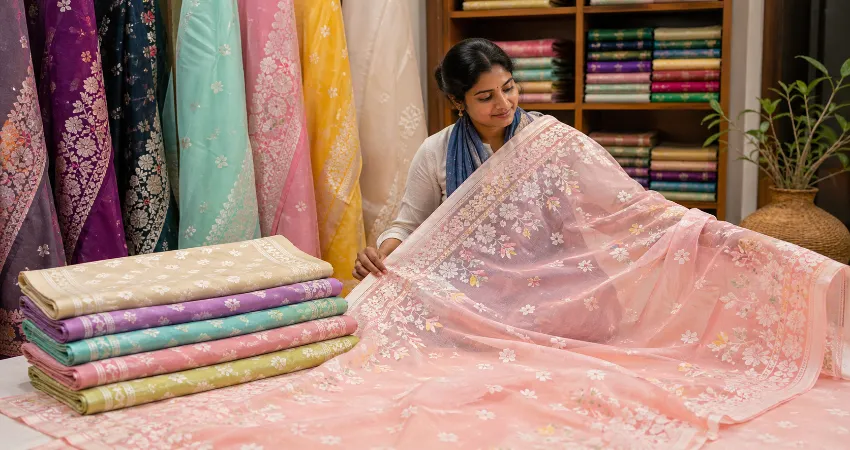
Few textiles anywhere in the world carry the historical weight that the Jamdani saree does. Originating in Dhaka more than two thousand years ago, this hand-woven fabric was prized so highly during the Mughal period that it circulated among royalty and court officials across Central and South Asia.
Ancient accounts suggest that when Roman traders reached the Bengal region, the muslin cloth woven there — so fine it could be bundled into a matchbox — was among the most valued commodities they encountered.
Today, Jamdani weaving holds UNESCO Intangible Cultural Heritage status, and the sarees produced under this tradition remain among the most technically demanding and culturally significant textiles produced anywhere on earth.
The appeal of authentic Jamdani for international buyers has never been stronger. Women across North America, the United Kingdom, Europe, and the Gulf are actively seeking genuine hand-woven pieces directly from Bangladesh, bypassing mass-produced imitations that replicate the look without the craft.
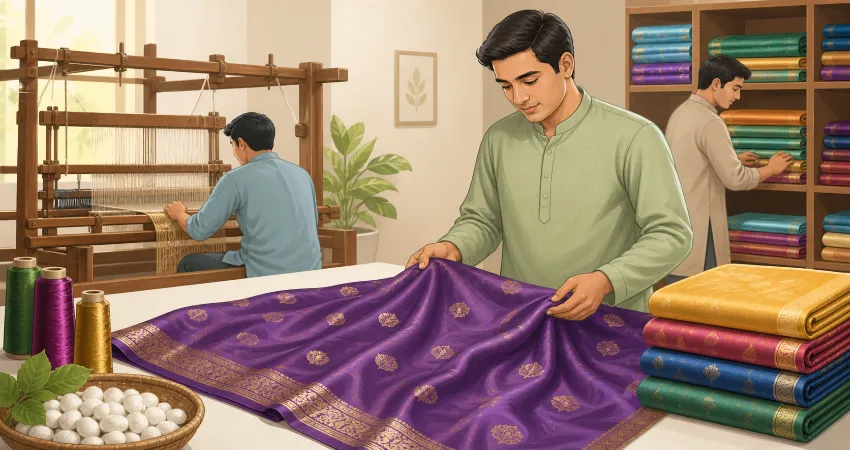
A single authentic Jamdani saree can take anywhere from several weeks to three years to complete — the time determined entirely by the density of the pattern and the fineness of the thread count.
What follows is a guide to ten of the best vendors currently serving global buyers who want genuine Jamdani sarees, not machine-made approximations wearing the same name.
1. Aarong — Bangladesh’s Most Trusted Heritage Retail Brand with International Reach
Aarong, the retail arm of BRAC — one of the world’s largest development organisations — has been the most reliable bridge between Bangladeshi artisan weavers and international consumers for decades.
Its Jamdani collection is sourced directly from weaver communities, with the organisation’s established quality control and fair-trade commitments giving buyers confidence in both the authenticity of the product and the conditions under which it was made.
Aarong ships internationally from its online platform and has a physical presence in Dhaka that makes it accessible to visiting buyers.
For anyone approaching authentic Bangladeshi Jamdani for the first time and wanting an accountable, established vendor with a verifiable record, Aarong is the natural starting point.
2. Global Jamdani — Artisan-Direct Export from Narayanganj
Global Jamdani operates with a straightforward and admirable model: working directly with skilled weavers in Narayanganj — one of the traditional centers of Jamdani production adjacent to Dhaka — to bring genuinely handwoven sarees to international buyers.
Narayanganj has been a weaving hub for centuries, and the weavers here carry multi-generational knowledge of the supplementary weft technique that creates Jamdani’s signature floating motifs.
For buyers who want to reduce the distance between the loom and their doorstep, Global Jamdani’s direct-from-weaver approach eliminates the retail markup layers that accumulate when heritage textiles pass through multiple intermediaries before reaching international consumers.
3. Rong Polli — Dhaka-Based Multi-Outlet Retailer with Online Delivery
Rong Polli operates several physical showrooms across Dhaka — including in Dhanmondi, Mirpur, and Bashundhara City — and also maintains a Kolkata presence, giving it a genuine cross-border footprint that few Bangladesh-based Jamdani vendors can match.
The company structures its collection across three clear price tiers: entry-level pieces suitable for everyday wear start around BDT 3,000, mid-range pieces for festivals and gatherings run from BDT 6,000 to BDT 20,000, and premium sarees for weddings and grand occasions reach BDT 50,000 or more.
This transparent pricing architecture makes Rong Polli particularly useful for international buyers trying to understand how thread count and design complexity translate into price — one of the more opaque aspects of the Jamdani market for newcomers.
4. Pia Kaghar — Curated Heritage Collection Shipped Directly from Dhaka Weavers
Pia Kaghar takes a deliberate curatorial approach to its Jamdani offering — describing its collection as sourced directly from weavers in Bangladesh, with an emphasis on pieces that represent the genuine artistic tradition rather than commercially simplified versions produced to meet faster turnaround demands.
The vendor specifically positions its sarees as heritage objects that can take between six months and three years to complete, framing them not merely as fashion items but as investments in living craft history.
For buyers in North America and Europe who want something they can genuinely keep across generations, this positioning — and the curatorial standards it implies — makes Pia Kaghar worth serious consideration.
You May Like: Top 10 Best Sustainable Garment Factories In Dhaka For Ethical Sourcing
5. Tamal Boutique — Muslin Silk Jamdani with Transparent Pricing for Global Orders
Tamal Boutique has carved out a specific position in the global Jamdani market by focusing on muslin silk blends — combining the breathable lightness of cotton muslin with a silk element that adds sheen and drape particularly suited to formal occasions and weddings.
The vendor’s online platform is designed with the international buyer in mind, with transparent pricing, clear descriptions of materials and weave origins, and shipping to multiple countries.
For buyers who want the visual richness of a silk-adjacent textile while retaining the authentic handloom heritage of the Dhakai tradition, Tamal Boutique’s muslin silk range occupies a sweet spot that pure cotton vendors and pure silk vendors both miss.
6. Banglar Saree — Wholesale and Retail Dhakai Jamdani with Direct Artisan Sourcing
Banglar Saree operates at the intersection of wholesale and retail, making it relevant to both individual buyers purchasing a single special piece and commercial buyers seeking consistent supply of authentic Dhakai Jamdani for retail or resale purposes.
The company works with artisans who follow traditional handloom procedures — the slow, meticulous process of navigating thin yarn strands to build geometric, floral, and figurative motifs directly into the weave structure.
For international buyers who want the flexibility to order in volume without sacrificing the handwoven authenticity that separates genuine Jamdani from machine-printed imitations, Banglar Saree’s hybrid wholesale-retail capability fills a genuine gap in the market.
7. Shenext Fashion — Dhakai Jamdani Specialists for Canada and the USA
Shenext Fashion has built its offering specifically around the North American South Asian diaspora — women in Canada and the United States who want authentic Dhakai Jamdani sarees for weddings, Durga Puja, Eid celebrations, and cultural events, but who find it logistically difficult to source directly from Bangladesh.
The company positions itself on three promises: guaranteed authenticity, global shipping with tracking, and a collection that mixes traditional designs with contemporary color stories that appeal to diaspora buyers whose aesthetic sits between heritage and modern.
For buyers in North America who have been disappointed by machine-printed sarees sold under the Jamdani name, Shenext’s explicit authenticity commitment and diaspora-focused service model represent a meaningful alternative.
8. Mirraw — Indian Platform Stocking Genuine Jamdani with Fast US and UK Shipping
Mirraw is an Indian online saree platform that has built a substantial catalogue of authentic Jamdani sarees — including both Dhakai variants originating from Bangladesh’s weaving tradition and West Bengal Jamdani that continues the same craft in India.
The platform’s scale gives it supply chain access that smaller single-vendor operations cannot always match, and its fast delivery infrastructure to the USA and UK makes it a practical option for international buyers who need shorter shipping timelines.
For buyers whose priority is delivery speed alongside authenticity, Mirraw’s operational scale positions it as one of the most accessible global delivery options for genuine Jamdani in the current market.
9. Bengal Looms — Handwoven Silk Jamdani for Premium Global Buyers
Bengal Looms focuses on the premium end of the Jamdani market, specifically handwoven silk Jamdani sarees that combine the traditional weave structure with silk threads to produce pieces of exceptional visual richness. These are not everyday wear sarees — they are occasion pieces, heirloom textiles, and gifts intended to communicate significance.
The vendor’s positioning at the premium tier means its customer base tends to be buyers who understand what they are looking for and are willing to pay accordingly for authenticity and quality.
For international gift buyers, wedding trousseau sourcing, and buyers who want something they can pass to the next generation, Bengal Looms’ premium handwoven silk catalogue is worth exploring carefully.
10. IndyVogue — Contemporary Jamdani with Heritage Technique for Modern Wardrobes
IndyVogue takes an interesting position in the Jamdani market by explicitly targeting buyers who want the craft heritage preserved but presented in color palettes and design arrangements that suit contemporary wardrobes rather than purely traditional occasions.
Its Jamdani collection includes pieces with Gujarat mirror work and hand embroidery added to the woven base — creating hybrid sarees that respect the weaving tradition while offering additional decorative layers that contemporary buyers find appealing.
You May Like: Top 10 Best Eco-Friendly Jute Rugs From Bangladesh For Modern Homes
For international buyers who want to wear Jamdani to a modern event rather than strictly a cultural occasion, IndyVogue’s contemporary-heritage hybrids serve a genuine market need that more traditional vendors do not always address.
FAQs About Best Authentic Jamdani Saree Vendors
1. How do I know if a Jamdani saree being sold online is genuinely authentic?
Three things signal authenticity: the vendor explicitly states hand-woven production on a traditional loom, the motifs are created within the weave itself rather than printed or embroidered on top, and the price reflects the genuine labor involved — a proper Jamdani takes weeks to years to complete. Machine-made imitations are priced far below what authentic handwoven pieces cost. Thread count specifics (60, 80, 84 count) mentioned by the seller also indicate knowledge of the genuine craft.
2. What is the difference between Dhakai Jamdani and West Bengal Jamdani?
Dhakai Jamdani originates from Dhaka, Bangladesh, where the craft began and where it received its UNESCO recognition. West Bengal Jamdani continues the same weaving tradition on the Indian side of Bengal, carried forward by weaver communities that migrated or maintained the technique independently. Both are genuine handloom sarees using the supplementary weft technique. Dhakai pieces are generally considered the most historically and technically authoritative, and they typically command higher prices.
3. What price range should I expect for an authentic Jamdani saree shipped internationally?
Entry-level handwoven Jamdani with simpler patterns starts around BDT 3,000 (approximately $25–30 USD) in the Bangladesh domestic market. Mid-range festival and occasion sarees typically run BDT 6,000–20,000 ($55–180 USD). Premium wedding-quality pieces with dense patterns and high thread counts reach BDT 50,000 and beyond ($450+ USD). Add international shipping costs — typically $20–60 USD depending on destination and urgency. Any Jamdani priced below this range internationally deserves careful authenticity scrutiny.
4. How long does it take to receive an authentic Jamdani saree with global shipping?
Delivery time depends on vendor location and shipping method. Most Bangladesh-based vendors offering international shipping use courier services with 7–21 day delivery windows to the USA, UK, and Canada. Some India-based platforms like Mirraw offer faster shipping options in the 5–10 day range for premium delivery tiers. Custom or made-to-order pieces require the weaving time on top of shipping — which can extend the total wait to several months for complex patterns.
5. Is Jamdani weaving genuinely at risk of disappearing, and does buying from authentic vendors help?
Yes on both counts. The weaving community in and around Dhaka and Narayanganj has declined significantly over the past century as machine-made imitations undercut handloom economics. Every purchase from a vendor sourcing directly from weaver communities creates economic incentive for the next generation of weavers to continue the craft rather than abandon it for industrial employment. Buyers who choose verified handwoven pieces and pay fair prices are directly contributing to the survival of a UNESCO-recognised intangible cultural heritage.
Conclusion
The global appetite for authentic Jamdani sarees reflects something deeper than fashion — it is a desire to own and wear a piece of living history, produced by hands that carry knowledge refined across two millennia.
Whether you choose Aarong’s accountable fair-trade sourcing, Global Jamdani’s direct-from-weaver approach, Rong Polli’s transparent price-tier structure, or Shenext Fashion’s diaspora-focused North American service, the most important commitment you can make as an international buyer is to authenticity over price.
A genuine Jamdani takes time, skill, and cultural understanding to produce. Paying what it is genuinely worth — and buying from vendors who source it honestly — is how a craft that Roman traders once traveled thousands of miles to acquire survives into the next century.