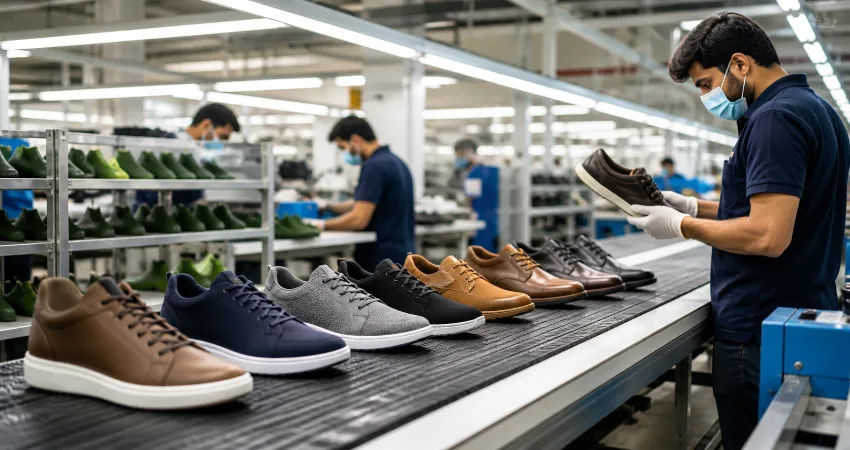
Bangladesh’s footwear sector is experiencing one of its most significant growth periods in recent memory. The country ranked as the 18th largest footwear exporter globally as of 2025, and export earnings rose more than 34 percent in FY2024–25 — a surge that reflects both improving factory capabilities and a deliberate buyer shift away from China toward lower-cost alternatives with comparable quality.
The sector employs close to 200,000 workers, exports to over 100 countries, and supplies recognizable global brands including H&M, Puma, Decathlon, Fila, and Kappa across categories spanning leather dress shoes, synthetic sneakers, sports footwear, sandals, and jute-based espadrilles.
Production is concentrated in two geographic clusters: Dhaka’s satellite towns of Savar and Gazipur form the primary manufacturing hub, while Chittagong handles export-oriented operations with better port access. Bangladesh’s cost advantage over regional competitors runs between 15 and 25 percent at comparable quality tiers, making it particularly relevant for mid-market and bulk-order buyers. T
he five manufacturers profiled here represent the strongest options for international buyers seeking export-quality output across leather, synthetic, and specialty footwear categories.
1. Apex Footwear Limited — South Asia’s Largest Leather Footwear Exporter
Apex Footwear Limited stands apart from every other footwear manufacturer in Bangladesh by a margin that remains difficult to overstate. The company is South Asia’s largest footwear exporter by volume, producing several million pairs annually and exporting across 40 countries to retail partners including Macy’s, Deichmann, and ABC Mart. Its workforce of over 7,500 people operates across 120 cutting machines, 24 sewing lines, and 12 assembly lines.
Apex also runs Bangladesh’s only LWG Gold-rated tannery — the highest environmental classification available for leather processing globally — giving it a supply chain credential that no domestic competitor can currently match. The company releases two international design collections annually, adding over 1,000 new styles per season, making it relevant for buyers who need design collaboration alongside production capacity.
2. Maf Shoes (TK Group) — Synthetic Footwear at Scale with 50,000 Daily Pairs Capacity
Maf Shoes, operating under the TK Group banner, is among the pioneers of synthetic footwear manufacturing in Bangladesh and holds a production capacity that few domestic competitors approach: 50,000 pairs per day across its manufacturing operations, with annual export volume exceeding 15 million pairs.
The company supplies international buyers across Europe and Asia, and its managing director has publicly noted that the synthetic segment’s quality and design improvements have driven meaningful order shifts from China toward Bangladesh among its client base.
For international buyers whose sourcing requirements center on sports shoes, casual synthetic footwear, or athletic styles in high volume, Maf Shoes has the capacity, the export experience, and the established global buyer relationships to support large-scale procurement reliably.
3. Akij Footwear Limited — Italian and German Machinery with Foreign Technical Expertise
Akij Footwear Limited is the footwear manufacturing arm of the Akij Group — one of Bangladesh’s largest and most financially stable conglomerates — and distinguishes itself through a specific and credible quality proposition: its production facility is equipped with machinery imported from Italy and Germany, and the technical team includes foreign experts engaged specifically to maintain international production standards.
This combination of European equipment and overseas technical input gives Akij Footwear a manufacturing floor capability that is meaningfully different from factories relying on domestic or lower-cost imported machinery.
For buyers placing premium-tier orders where equipment precision and finishing quality are critical specifications, Akij Footwear’s infrastructure investment represents a practical differentiator within the Bangladesh market.
4. Craftsman Footwear and Accessories — Quality-Driven Manufacturer Targeting Premium Finishing
Craftsman Footwear and Accessories has positioned itself at the premium finishing end of Bangladesh’s export footwear market — the tier where international buyers need the kind of surface quality and construction consistency that commands placement in mid-to-high retail environments rather than discount channels.
The company’s Corporate Director, who returned to Bangladesh after nearly two decades in Canada, has driven a quality-first orientation that is visible in the factory’s approach to materials sourcing and finished goods inspection.
Craftsman is specifically cited in Daily Star reporting on Bangladesh’s leather and footwear sector as a manufacturer whose ambitions and output quality align with where the country’s sector needs to go to compete for premium global market share rather than remaining in the commodity export tier.
5. Shoeniverse Footwear Limited — Seven-Brand European Supplier with Active Expansion
Shoeniverse Footwear Limited has built a specific and commercially significant position in Bangladesh’s synthetic footwear export landscape: it currently supplies products to seven global brands operating in European and Indian markets, with an additional eight international buyers actively in negotiation at the time of the most recent public reporting.
The company’s managing director has attributed Shoeniverse’s growth directly to quality improvements that have made Bangladesh footwear competitive enough to attract buyers previously committed to Chinese suppliers.
For international sourcing teams seeking a mid-sized Bangladesh manufacturer with an existing multi-brand European supply record — rather than a factory still building its first export relationship — Shoeniverse’s active client roster and expansion momentum make it a particularly credible shortlist option.
FAQs About Best Export-Quality Footwear Manufacturers
1. How competitive is Bangladesh for footwear sourcing compared to Vietnam and China in 2026?
Bangladesh offers 15–25% lower production costs than most Asian footwear competitors and benefits from GSP duty-free EU access that Vietnam and China do not share equally. The trade-off is that Bangladesh’s finishing capability for premium leather footwear still lags behind Vietnam and China at the top tier. For mid-market casual, synthetic, and sports footwear at bulk volumes, Bangladesh is increasingly competitive on both price and quality.
2. What types of footwear does Bangladesh export most competitively?
Bangladesh’s strongest export categories are synthetic casual footwear, sports shoes, sandals, flip-flops, jute-based espadrilles, and mid-market leather dress shoes. Leather footwear exports recovered strongly in H1 FY2024–25, up 30% year-on-year. Synthetic and non-leather categories continue growing as global consumers shift toward non-leather alternatives, with Bangladesh’s production quality in this segment improving meaningfully over the past five years.
3. Which international brands currently source footwear from Bangladesh?
Bangladesh supplies footwear to H&M, Puma, Decathlon, Fila, Kappa, Macy’s, Deichmann, and ABC Mart, among others. Export destinations include Spain, France, the Netherlands, Germany, Italy, South Korea, and India. The diversity of brand clients across price tiers — from value-positioned retailers to mid-market department stores — indicates that Bangladesh’s footwear quality range is broader than its historic commodity reputation suggested.
4. What certifications should international buyers verify for Bangladesh footwear manufacturers?
The most important certifications to verify are LWG (Leather Working Group) for tannery operations, BSCI or Amfori for social compliance, WRAP for factory-level ethical standards, ISO 9001 for quality management, and OEKO-TEX for chemical safety in finished goods. Only Apex Footwear currently holds LWG Gold — the highest tannery environmental rating. Always request current certification documentation with valid expiry dates.
5. Does Bangladesh footwear manufacturing have GSP duty-free access to the EU?
Yes. Bangladesh currently benefits from EU GSP (Generalized System of Preferences) duty-free access for footwear exports as a Least Developed Country. This arrangement is subject to review as Bangladesh progresses toward LDC graduation, which has been discussed in the context of 2026 and beyond. Buyers sourcing for EU markets should verify the current GSP status and tariff schedules with Bangladesh’s Export Promotion Bureau or their EU customs authority before finalizing long-term supply contracts.
Conclusion
Bangladesh’s export footwear sector in 2026 offers international buyers a genuinely broader capability range than its historical reputation for commodity leather goods suggests.
Apex Footwear’s LWG Gold tannery and 40-country export network set the premium benchmark, Maf Shoes’ 50,000-pairs-per-day capacity addresses high-volume synthetic needs, Akij Footwear’s European machinery investment supports quality-tier production, Craftsman targets the premium finishing market, and Shoeniverse demonstrates that a mid-sized manufacturer can build a credible multi-brand European supply record from a Bangladesh base.
GSP duty-free EU access, a 34% export earnings surge in FY2024–25, and a skilled workforce now calibrated to international buyer expectations make this a sector worth serious sourcing consideration in the year ahead.